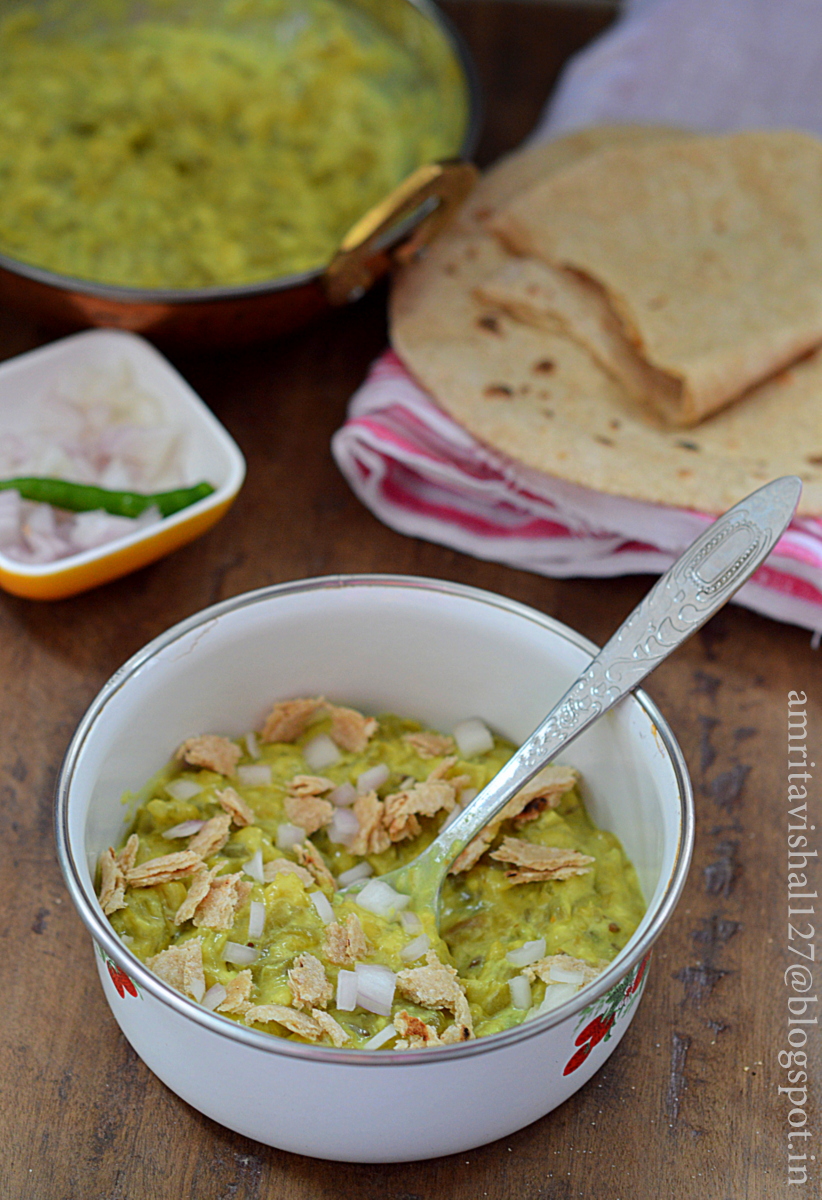
As Winter comes, all homes in Punjab get geared up to prepare the most important, the most loved and the most respected meal-Sarson da saag and Makai di roti. This is not just another meal for us but is a meal which is synonymous to our culture and our existence. The sight of beautiful yellow flowers on the mustard plant are an invitation to the most coveted and most awaited meal during Winters.
This hearty and healthy combination is supposed to warm the bodies to fight the bitter cold. The entire process of making Sarson da saag is not just a process but a ritual which is done very religiously.
On my recent visit to Punjab, I was lucky to have sarson da saag from someones fields which was fresh and organic. The stem of the leaves of sarson da saag is called 'Gandalan' and a saag made using this part is supposed to be the best saag. The stem is first peeled and this is called 'Chirana' to remove any hard fibre and then all the leaves are washed. The leaves are then chopped using a traditional 'Daat' which is very much like a 'Boti' used in Bengal. The leaves are then cooked in the pressure cooker along with ginger-garlic-green chilly paste and then the saag is mashed using a traditional 'Madani' or 'Ghotna'. Makai atta is then added little by little to thicken the saag and give it some body. This is called 'Aalan'. Alternatively, besan or gehun atta can also be used. The saag is then again put to cook the rawness of the atta.
Usually saag is cooked in more quantity as it stores very well. In fact, the older it gets the more tastier it gets. When required, a tadka of onions and tomato is given to the saag which is then served with a dollop of white butter or 'Chitta Makhan'.
Since a recipe of Sarson da saag is so common and readily available everywhere on the net, I was more interested to present it in a little different and modern way. The perks of having an amazing Chef friend is that you can discuss your food planning and get incredible ideas and tips. And that is what lead me to attempt my hands on a Makai da tart. The entire innovative credit goes to my friend cum super chef Vikas Puri who very patiently helped me plan the styling.
The recipe credit goes to my dear Kamal Masi who also very patiently helped me click and document each step of Saag making. The recipe and method shared here is the traditional way we make it at our home.
This hearty and healthy combination is supposed to warm the bodies to fight the bitter cold. The entire process of making Sarson da saag is not just a process but a ritual which is done very religiously.
On my recent visit to Punjab, I was lucky to have sarson da saag from someones fields which was fresh and organic. The stem of the leaves of sarson da saag is called 'Gandalan' and a saag made using this part is supposed to be the best saag. The stem is first peeled and this is called 'Chirana' to remove any hard fibre and then all the leaves are washed. The leaves are then chopped using a traditional 'Daat' which is very much like a 'Boti' used in Bengal. The leaves are then cooked in the pressure cooker along with ginger-garlic-green chilly paste and then the saag is mashed using a traditional 'Madani' or 'Ghotna'. Makai atta is then added little by little to thicken the saag and give it some body. This is called 'Aalan'. Alternatively, besan or gehun atta can also be used. The saag is then again put to cook the rawness of the atta.
Usually saag is cooked in more quantity as it stores very well. In fact, the older it gets the more tastier it gets. When required, a tadka of onions and tomato is given to the saag which is then served with a dollop of white butter or 'Chitta Makhan'.
Since a recipe of Sarson da saag is so common and readily available everywhere on the net, I was more interested to present it in a little different and modern way. The perks of having an amazing Chef friend is that you can discuss your food planning and get incredible ideas and tips. And that is what lead me to attempt my hands on a Makai da tart. The entire innovative credit goes to my friend cum super chef Vikas Puri who very patiently helped me plan the styling.
The recipe credit goes to my dear Kamal Masi who also very patiently helped me click and document each step of Saag making. The recipe and method shared here is the traditional way we make it at our home.

Ingredients :
 |
| Organic greens-fresh produce from the farms |
Sarson da Saag- For 7-8 servings
- 3 bunch Sarson saag (Mustard leaves)
- 1 bunch palak (spinach)
- 1 bunch bathua (chenopodium leaves)
- 1 bunch methi (fenugreek leaves)
- 1 bunch methe, optional (a variety of fenugreek leaves)
- handful of garlic leaves
- 2 tbsp ginger-garlic paste
- 3-4 green chillies (less or more, according to taste)
- 2 tbsp makai atta (maize flour)
- salt to taste
- ghee
Procedure :
Sarson da saag :
Peel the ends of the stems of the Sarson saag leaves. The stems are called 'Gandal' and a saag made of these gandals is a delicacy. Popularly saag made of these stems is called 'Gandalan da saag'.

Wash all the leaves and then chop them. Traditionally it is done with an instrument called 'daat' in Punjabi (also called 'boti' in Bengali).

Heat 3 cups water in a pressure cooker and keep adding the chopped greens to it. Add more water if required. The chopped greens should get just about soaked in the water.

As the leaves get cooked, they will change colour and settle down. Stir it once in a while. Meanwhile prepare ginger-garlic-green chilly paste by grinding them all together.
Traditionally, it is done in a vessel called 'Kunda-Sota' where an earthen vessel is the 'Kunda' and a wooden stick is the 'Sota'. The masala is pounded in the kunda with the sota.
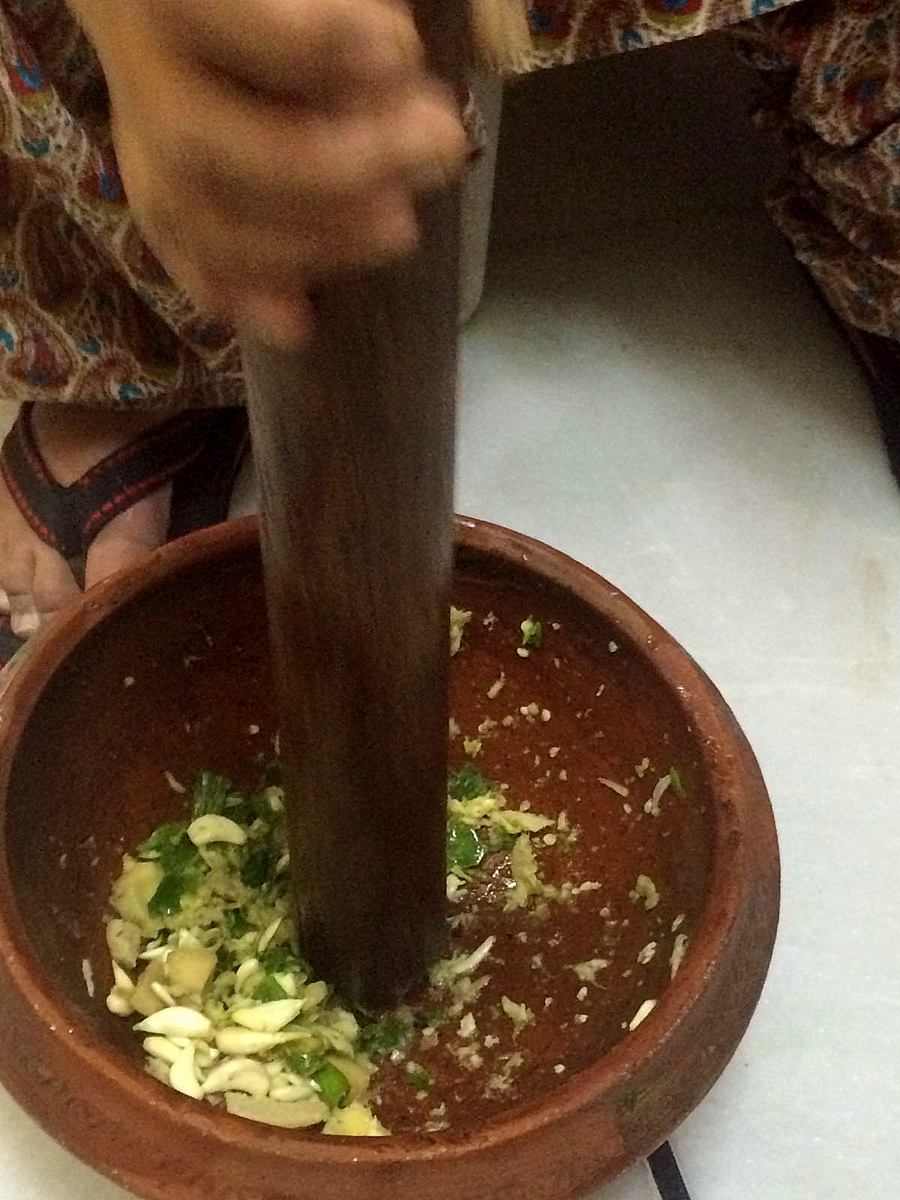
Add the ginger-garlic-green chilly paste in the saag and mix it well. Add salt to taste.

Close the lid of the pressure cooker and allow one whistle on high flame. Thereafter, reduce the flame to minimum and let the saag cook for one hour.
Let the steam escape and then mix the saag with a hand mixer. Traditionally a 'Madani' is used which is wooden and is popularly used to make Lassi.
The saag is basically mashed up with the Madani which requires good arm strength.

Once mashed, little by little makai atta is added to thicken the saag. Keep adding and mixing to reach a required consistency. Put the saag back to heat for about 5 minutes so that the rawness of the makai atta goes away.

The saag will look something like this pic below-fruit of hard labour and love that goes into making it.

Saag at this stage can be stored in the fridge for many days. Whatever amount is required is taken out, given a tadka and then eaten.
For Tadka, take ghee/refined oil in a pan and add chopped onions. As they brown a little add chopped tomatoes and then add saag.
Do not forget to add the most important and coveted ingredient on top of saag before serving-a big dollop of white butter !
 |
| Sarson da saag with Makai di roti |
 |
| Sarson da saag with Bajre di roti |
Makai di roti :
- Makai atta (a handful for each roti required)
- hot water for kneading
- ghee for brushing
Procedure :
Take makai atta in a bowl and add little by little hot water into it. I initially stir it with a spoon as the water is hot but usually women in Punjab are so used to handling the hot water due to extreme winter that they do the entire kneading with hand.
Knead it to a soft dough and keep aside covered with a wet cloth.
They say that the makai atta because of its coarse nature yields softer roti's if kneaded with hot water.
I take a plastic sheet and put the required ball of dough inside, cover again with the plastic sheet and then roll the roti with a rolling pin. Very commonly in Punjab women make it by just placing the ball of dough on a plastic sheet and using wet fingers to make the roti. In earlier days women were expert to make the roti by just using their two hands, no plastic sheet, no rolling pin.
Heat a tawa and place the roti on it. Let it cook both sides and then add ghee on at least one side to let it cook and get some dark brown spots on it.
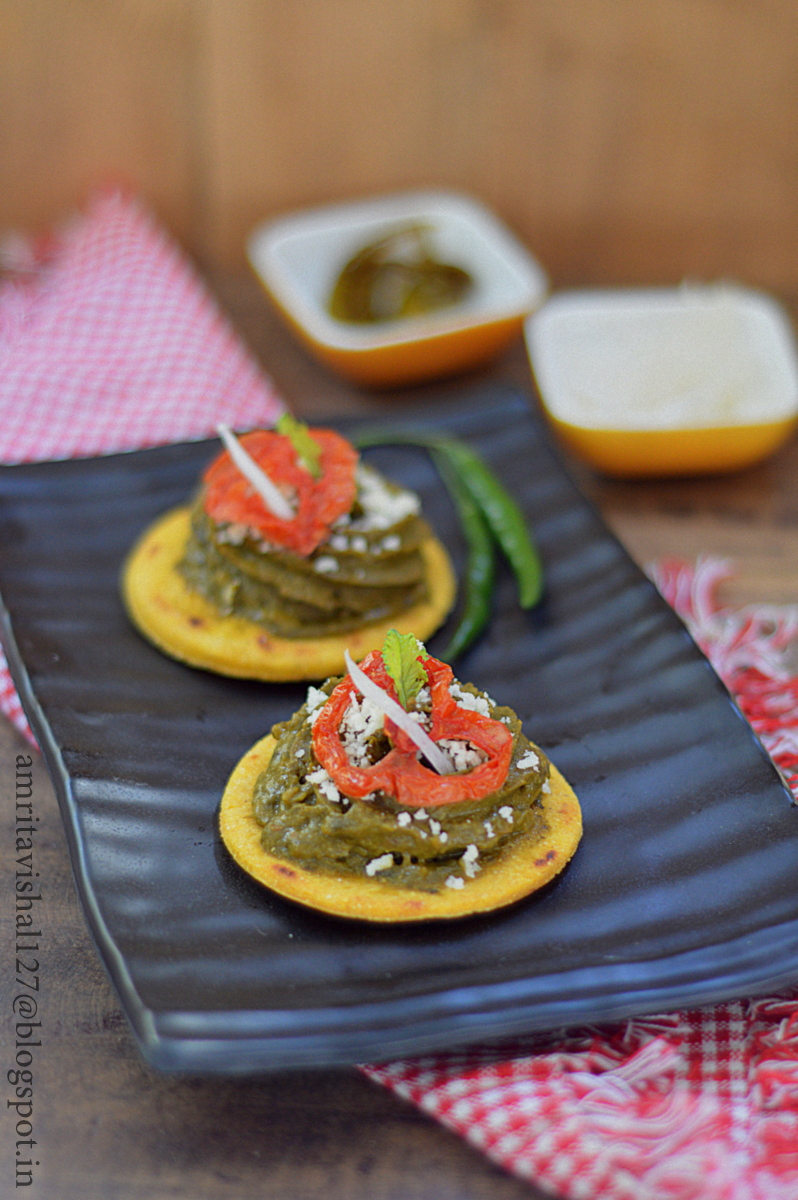
For a modern presentation, you may make small roundels of makai di roti and spoon the saag on it or you may even put saag in a piping bag and pipe on the roti like I did. Remember to keep the saag thick for this presentation. Grate some fresh paneer on top. Oven roast some slices of tomato with a sprinkle of salt and garnish on top. I used juliennes of white radish for garnishing and baby leaf of white radish.

Makai di Tart : for 2-3 tartlets
- 3/4 cup makai atta (maize flour)
- 2-3 tbsp maida (all purpose flour)
- 40 gms cold butter cut in cubes
- little cold water for kneading dough
- a pinch of salt
Procedure :
Take Makai atta, all purpose flour and salt in a bowl and mix it. Add cold butter cubes in it and then rub the flour with the butter till the mixture resembles breadcrumbs in texture. Add little cold water (as much required) and knead to a dough. Wrap the dough in a cling wrap or a plastic sheet and refrigerate for 30 minutes.
Preheat oven to 180 degree Celsius.
Take the dough out from the fridge and leave it for 5-10 mins. Roll it out with a rolling pin and line a mini pie tin with it. Press it in the mould and cut excess from the edges. Take a fork and make few impressions to allow air to escape while baking so that the dough does not puff up.
Bake for 10-15 minutes or till the tart is done.
Cool it and remove from tin.
Spoon a thick consistency of saag in it or pipe it with a star nozzle, as I have done. Garnish with a sprinkle of grated paneer, oven roasted tomato, julienne of radish and a radish leaf.

Happy relishing
Amrita