Showing posts with label Saffron. Show all posts

Wednesday, 4 March 2015

Kesari Kheer


Desserts have always been a part of our daily meals when I was growing up, especially the milk based ones. Being a Sikh, milk has always been present in surplus in our house. I have memories of going along with my Grandmother, my Beji, to the milkman or gwala who would milk the buffaloes in front of us and give us fresh milk. From drinking milk as it is to using it in endless desserts, Beji would ensure her family is fed well with milk along with other things. I guess, there is just some connection with milk and being a Punjabi
Kheer is one of the most common milk based desserts found in most households irrespective of the region. Known with different names, the simple preparation of rice cooked in milk is called payesh in Bengal and is called payasam in the Southern states. Adorned with dry fruits and saffron threads, a simple kheer is made special for occasions. 
With Holi round the corner, I was reminded of this simple kheer preparation that has been part of my growing years. 

Ingredients : For 3-4 servings
  • 500 ml full cream milk
  • 1/2 cup rice (I used Gobindbhog)
  • 1/2 cup or less sugar (according to your taste)
  • cardamom powder
  • saffron threads
  • almonds
  • pista
Procedure : 
Wash and soak rice for half an hour.
Take milk in a heavy bottomed vessel and bring it to a boil.
Add the washed and soaked rice to the milk.
Lower the heat and allow the milk and rice to cook for about 45 minutes or till it thickens to the required consistency. Keep stirring in between.
Meanwhile soak saffron threads in little warm milk. 
Add sugar to the milk-rice mixture and mix well. Adjust sugar to your liking.
Adding sugar will make your kheer a little thin so cook till it thickens again. 
Remove from heat and stir in the saffron threads and cardamom powder.
Allow to cool and garnish with chopped almonds and pista. 
Serve chilled. 
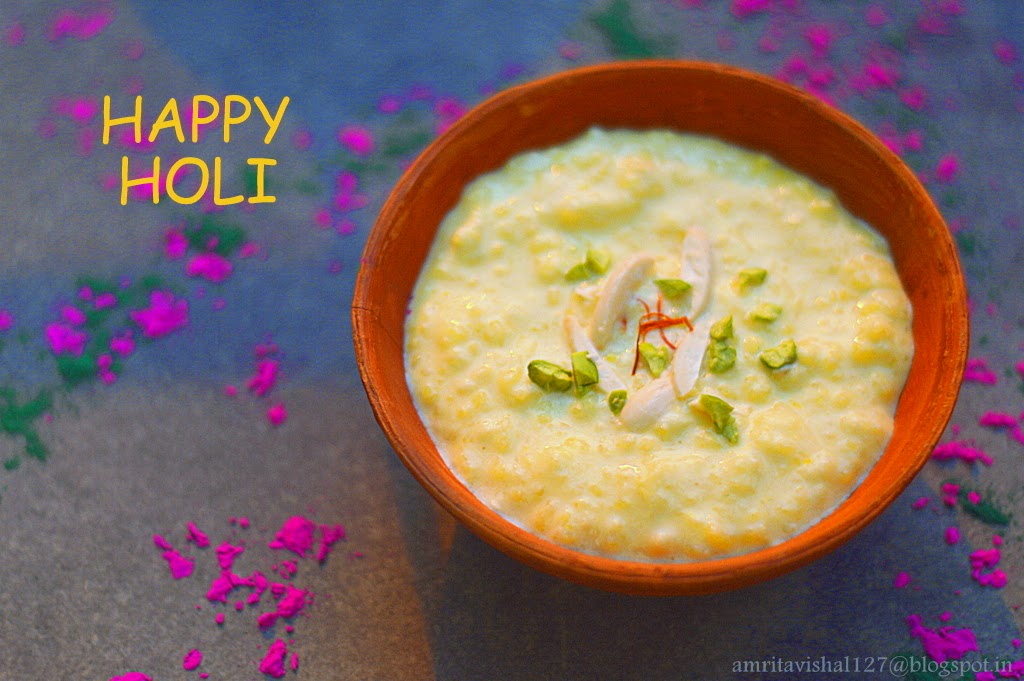


Happy Holi
Amrita

Saturday, 26 October 2013

Kakori kebab


Food cooked in charcoal and wood fire has an unreserved allure universally that draws its roots since the ancient of days. Being the most primitive form of cooking since the stone age, when man discovered the wonder of creating fire from sparks by striking two stones together, it has been ingrained into the genes of humankind and forms a part of the DNA of the Food-logy of our being. Even today, after centuries of existence, evolution and technological advancement, coal and wood fire continue to serve mankind with both, the exquisite range of grilled and barbecued spreads and provision in the form of the cheapest cooking alternative for countless folks worldwide struggling to make ends meet.  
Amongst the endless list of techniques and recipes from the wood fire nothing perhaps is more illustrious, loved and accepted than the middle eastern range of  kebabs and grills.
The English phrase 'all dark clouds have a silver lining' and William Shakespeare's widely quoted line from the play 'As You Like It' (Act 2 Scene 1) "Sweet are the uses of Adversity" couldn't be more true than its significance with regard to the invention of the legendary Kakori Kebabs when the adversities of the old and toothless Nawab of Awadh made his khansamas grind their teeth in order to create the kebab that literally melts and evaporates like a wafer. 
My quest, in addition to the natural attraction towards charcoal grilled food, was to replicate the Kakori Kebabs that had blown away the imagination of my mind and left me spell bound with its dramatic melting texture and softness and the subtle exquisite flavours that translates into pampered royalty incensed with the most exuberant spices and the aromatic smell of the charcoal grill. After much attempts, and a recipe, I did manage to achieve something I would categorize the likes of Kakori Kebab. 
There are many steps in the process. The key in creating the Kakori Kebab is doing those small steps right. Choosing the meat is the most vital step as that determines the ultimate outcome of the kebab even if you have got the other steps right. 


Ingredients : Serves 4-5

  • Minced Mutton (Goat) Meat - 500 gms (The meat should be chosen from the raan, or the leg, without any fat or ligaments. 
  • Raw Papaya - 50 gms
  • Kidney fat - 50 gms
  • Salt to Taste 
(A) Kakori Masala (Roast and Make Powder)
  • Green Cardamom 5 pcs
  • Black Cardamom Seeds 1/2 teaspoon
  • Cloves - 3 Nos
  • Nutmeg - a Pinch
  • Mace/Javatri - 1 Small Blade
  • Shahi Jeera- 1/2 Teaspoon
  • Rose Petal - 1/2 teaspoon
  • Kebab Chini - 5 Nos
  • White Pepper - 1/2 teaspoon
  • Kashmiri Mirch powder- 1/2 tablespoon
  • Roasted Gram Powder - 3 tbsp

(B) Kakori Masala (Make Paste)
  • Dessicated Coconut - 3 tbsp
  • Khuskhus (Poppy Seeds) - 1 tsp
  • Khoya - 1 tbsp
  • Onions (to be sliced and fried) - 4 medium sized
  • Cashew nuts - 1 tbsp
  • Fresh Malai - 1 tbsp
  • Saffron - a pinch
  • Rosewater - 1 tablespoon
  • Kewda Water - 1 Tablespoon


Process:
  • Mince Meat and Fat thrice to a very fine consistency in  a grinder.
  • Add papaya paste, salt and Kakori Powder (A), mix well
  • Add Kakori Masala (B) along with Rose water, Kewda and Saffron.
  • Mix thoroughly and keep for half an hour.
  • Take a portion of the meat (about 100 gms) and put it on skewers and shape it like a seekh kebab (the skewer type should be fat square shaped since they hold the minced meat the best).
  • Roast on charcoal grill. Be careful to turn the seekh constantly to avoid over grilling from a particular side. Alternatively preheat oven to 200 degree Celsius and grill kebab for 15-20 mins or till browned from all sides. Remember to oil the kebabs in between for better and uniform grilling.
  • Remove Carefully from the skewer on a plate. 
  • Serve with green chutney and sliced onions (although it was loved without any chutney)
(Recipe Credit: Gautam Mehrish : Corporate Executive Chef at Sun-n-Sand Hotels, Mumbai)


The same recipe when experimented with minced chicken was not exactly the 'melt-in-mouth' texture but was equally appreciated.

The same recipe experimented with chicken

Happy Kebab Dishing
Vishal

Saturday, 5 October 2013

Malai Chamcham


It is such a great pleasure for me to introduce to you, in continuation to the series of 'Know Your Kolkata Food Blogger', a very special blogger who is as humble as her accomplishments are in the world of great food that she has been churning up for so many years. In fact, she has been in the sphere of blogging for so many years that she would need no introduction and chances are that you would have already known and read her blog. Sayantani Mahapatra, blogging from 'A Homemaker's Diary' is our blogger of the week and truly a dear friend who is always ready to lend a helping hand. She has been an inspiration to many and her works speaks volume of an in-depth understanding of food and cuisines. She has a keen interest in crafts and her home is a reflection of her amazing knack in interior decoration too. Always with a smile to adorn her kind face, Sayantani is one of the most humble people I have met. 
For this event, my recipe for recreation was chosen long back. I had been eyeing her Malai Chomchom and waiting for an excuse to attempt it. With Sayantani's recipe I am always ensured to come out with amazing outcomes. I modified the recipe and made it a little milky for our liking. You may check her version and her detailed and easy to follow instructions.


Ingredients: For around 15 pieces

Chamcham :
  • 1 1/2 litre milk (Ideally full fat or cow's milk, but I used Amul Taaza)
  • 1/2 tsp citric acid or 1 tbsp lemon juice
Sugar syrup :
  • 1 cup sugar
  • 3 cup water 
Malai syrup :
  • 2 cups milk
  • 3 tbsp condensed milk
Garnish 
  • chopped pista
  • saffron threads

 Procedure :

Chamcham 
Heat milk in a pan and let it come to a boil. Add citric acid/lemon juice and stir well. Soon you will see the milk curdling and whey separating. Wait till the whey separates well. Remove from heat and using a muslin cloth drain the chenna(curdled milk) from whey. (Do not throw whey, reserve it for using to make soft chapati dough or make yummy dal/gravy.)
Hang the muslin cloth to drain excess water for half an hours. Remove and put on a plate. Cover with another plate and put a heavy object to drain any remaining liquid for about half an hour.
Take out the chenna and knead with the heel of your palm till smooth and reaches dough consistency. This requires patience and strong arm muscles and can take around 10 minutes.
Make cylindrical shapes out of the kneaded chenna and keep aside. You may even make round shapes as in rasagullas.


Sugar syrup
Boil water and sugar in a wide pan and gently lower the chenna cylinders in it. 


Simmer on medium heat for around 15-20 mins or till they start floating on the surface.


Alternatively, take sugar and water in a pressure cooker and as the syrup comes to a rolling boil, lower the chenna cylinders. Put the lid on and cook on medium heat for 2 whistles. Allow the heat to dissipate naturally and take out the cooked chenna cylinders.

Malai syrup:
Take milk in a pan and let it simmer on medium heat till it reduces to half in quantity. This may take 10 mins. Now add the condensed milk in it and mix well. 
Remove from heat and transfer to a a wide bowl and soak the cooked chenna cylinders.


If you like a thicker consistency, let the milk reduce more before you add the condensed milk. 
Soak pista in warm water for 5 minutes and rub the skin to remove it. Chop pista.
Garnich with chopped pista and saffron threads.
I made a batch with the chenna shaped in rounds and soaked in the same syrup.

Happy Malai Chamcham Eating 
Amrita


Wednesday, 28 August 2013

Mawa/Khoya Cupcakes


Daring Baker's challenge for this month was hosted by Aparna of My Diverse Kitchen and she challenged us with some amazing Indian Bakes-Mawa cake, Bolinhas de coco(Coconut Biscuits) and Masala biscuits. Traditional Indian cuisine does not boast of baking at all but you may find some adapted recipes which were introduced by traders, invaders and colonial rulers. 
Mawa cakes are typically associated with Irani cafés found mostly in Mumbai, Pune and Hyderabad.These cafés, owned by Zoroastrians who emigrated to Mumbai from Iran in the 19th century to escape persecution of non-muslims, are famous for their good, honest, reasonably priced food and beverages. Some of the very popular food sold in these cafe's are ‘bun maska’ (bread and butter) and ‘paani kam chai’ (a strong Iranian tea), or khari chai (very strong tea), mutton samosas, and Keema Pavs, akuri (a scrambled spicy egg preparation), berry Pulao,  Veg/Chicken Dhansak (a spicy broth with lentils, pulses) and Biryani, cheese khari biscuits, shrewsbury biscuits...just to name a few.
Mawa, also called khoya, is made by reducing milk (usually full-fat) on low heat until all that remain is a mass of slightly caramelized granular dough-like milk solids. This is then used to make a rich and dense cake which along with cardamom and almonds gives it the rich and milky flavour.
I decided to make cupcakes and enhance the Indian flavours with some saffron infused milk that goes in the batter. Along with chopped pista and almonds on top, these cupcakes certainly are full of the true Indian essence.


Ingredients : I halved the recipe to yield 6 cupcakes and a 3 1/2" round small cake
  • 500 ml full fat milk
  • 1/4 cup butter, at room temperature
  • 5 tbsp packed crumbled mawa
  • 1/2 cup + 2 tbsp sugar, powdered
  • 1 egg
  • 2 cardamom pods, powdered
  • 1 cup cake flour (Add 2 tbsp cornflour in 1 cup measurement and fill the rest with all purpose flour)
  • 1/2 tsp baking powder
  • 1/4 cup milk
  • Cashewnuts to top
  • Chopped pista-little
  •  few saffron threads

Procedure :

Mawa :
Pour milk in a heavy bottomed pan and bring it to a boil. Turn down heat to medium and keep cooking the milk till it has reduced to a quarter of the original volume, stirring frequently. This can take between 30-45 mins. By now the colour of milk will be light brownish.
Keep stirring till the milk solids take a lumpy appearance. This is called Mawa/Khoya. Remove from heat and allow to cool.
This yielded around 1/2 cup mawa.
You may refrigerate the mawa for 2-3 days and bring it to room temperature while using it.

Mawa

Cupcakes :
Preheat oven to 180 degree Celsius.
Line cupcake moulds with liners or just grease them well. 
Warm milk and add 5-6 saffron threads and leave aside.
Beat butter, mawa (at room temperature) and sugar till soft and fluffy. I used my electric beater for it.
Add egg and the saffron infused milk(reserving the saffron threads to top on the cupcakes) and beat well.
Add cake flour, baking powder and cardamom powder and mix. 
Pour this batter in the prepared cupcake liners. (My batter was still in excess after filling 6 cupcake liners and so I prepared a 3 1/2" round cake tin and poured the leftover batter in it)
Place cashew nuts(I halved them lengthwise), saffron threads and chopped pista on the cupcakes and the small cake.
Bake for 25-30 mins or till a toothpick inserted in the middle comes out clean.
Allow to cool and serve.


Sending this recipe to the event Little Thumbs Up  which is co-hosted by my dear friend Yen from Eat your heart out  
Photobucket

This recipe is also a part of the amazing KFB blogging marathon that I am part of, along with my fellow members. Do drop in to check what they are doing here : 
A Homemaker's Diary
Silence Sings
My Food My Life
Recipe Junction


Happy Mawa cupcake Eating
Amrita

Wednesday, 14 August 2013

Polka dot Sandesh Cheesecake


Happy Independence day.
Sāre jahāñ se acchā hindostāñ hamārā ham bulbuleñ haiñ us kī vuh gulsitāñ hamārā
(Better than the entire world, is our Hindustan,
We are its nightingales, and it (is) our garden abode)


This Urdu poem written by Muhammad Iqbal is  perhaps the most endearing of all songs and is a gentle reminder of an era where people were ready to give up their lives for the love of their country. Along with mentioning the grandeur of our country this poem tells us that religion does not teach us to fight with each other, rather it teaches us to live in harmony.
The passion and the will to die that even the common man had at the time of Independence still amazes me to no end. How can one want to just go and die. How deep and true can such a love be. From young to elderly men/women, all were united to fight against the British Empire and free our country. Such is the power of togetherness and unity.
Can one even think of doing it today? What happens to those cases of murder and rape that we stand for which seem to fade off with time and our memories. Indeed a very grave question but an important one.

I think its time we celebrate true freedom by promoting a culture where Respect, Dignity and Equality are the main components. Lets try and live up to the dreams of those thousands of lives that happily laid down just so that you and me can live and breathe in a free country.
This Polka dot cheesecake is my humble ode to my country that I am extremely proud of. May the New India emerge with flying colours.


Ingredients : Serves 3-4. I used a 3 1/2" round cookie cutter to set the cheesecake

Sandesh
  • 700 ml milk
  • a pinch of citric acid/1/2 tsp lime juice
  • 3-4 tbsp powdered sugar
  • Few drops of orange and green food colouring
Cheesecake
  • 3-4 digestive biscuits
  • 1 tbsp melted/softened butter
  • 1/4 cup cream cheese(I used Philadelphia)
  • 1 tsp+ 1 tsp gelatin (for setting cheesecake in two layers)
  • 2 tbsp cold water for blooming gelatin
  • 2 tbsp powdered sugar
  • Chopped Pista and Saffron threads for garnishing

Procedure :

Sandesh 
Take milk in a pan and bring it to a boil.
Mix in the lime juice or citric acid and stir till you see the milk curdling and the whey separating.
Turn off the flame and let it stand for 2 mins. Meanwhile prepare a vessel by placing a muslin cloth or use a colander.
Strain the mixture into the muslin cloth. I usually save the whey to use it to knead my dough for roti or use it while boiling dal.
Bring the sides of the muslin cloth together and hang it to drain excess liquid for 30 mins. This is the Chenna.
Take the chenna in a plate and knead it with the heel of your palm for 5-10 mins till you get a smooth and doughy texture. 
Keep half of the chenna aside to use it in the cheesecake.
Add sugar to the remaining half and mix well.
Divide into 2 equal halves and add few drops of orange and green food colour respectively. Mix well.
Make small round balls out of it and keep them aside.


Cheesecake 
Place the biscuits in a kitchen towel/cloth and crush them with a rolling pin. Gather in a bowl.
Add melted/softened butter and mix well. 

Press the biscuit mixture evenly on the base of the cookie cutter. Refrigerate to set for 1/2 hour.
Sprinkle 1 tsp gelatin over 1 tbsp cold water and let it sit for 5 mins till it gets spongy. 
Take the remaining chenna and mix it very well with the cream cheese and sugar. Divide this mixture in two parts and warm the mixture. It should not be too hot. It should be warm enough to dip your finger. I microwaved my mixture for 10-15 secs. Add the bloomed gelatin to it.
Place the green coloured sandesh balls on the set biscuit base.


Pour the gelatin mixed part of the mixture on top of it.


Refrigerate for an hour or till set.
Place the orange coloured sandesh balls on it.


Sprinkle 1 tsp gelatin over 1 tbsp cold water and let it sit for 5 mins till it gets spongy.  
Warm the remaining chenna-cream cheese mixture and add gelatin to it. Pour on top of the orange coloured sandesh and refrigerate for 2-3 hours for the entire cheesecake to set well.
Garnish with chopped pista and few threads of Saffron.

Slice and surprise with orange and green polks dot sandesh inside.


Happy Independence day to all of you
Amrita

LinkWithin

Related Posts Plugin for WordPress, Blogger...