Showing posts with label traditional punjabi food. Show all posts

Thursday, 26 January 2017

Sarson da saag with Makai di tart


As Winter comes, all homes in Punjab get geared up to prepare the most important, the most loved and the most respected meal-Sarson da saag and Makai di roti. This is not just another meal for us but is a meal which is synonymous to our culture and our existence. The sight of beautiful yellow flowers on the mustard plant are an invitation to the most coveted and most awaited meal during Winters. 
This hearty and healthy combination is supposed to warm the bodies to fight the bitter cold. The entire process of making Sarson da saag is not just a process but a ritual which is done very religiously. 
On my recent visit to Punjab, I was lucky to have sarson da saag from someones fields which was fresh and organic. The stem of the leaves of sarson da saag is called 'Gandalan' and a saag made using this part is supposed to be the best saag. The stem is first peeled and this is called 'Chirana' to remove any hard fibre and then all the leaves are washed. The leaves are then chopped using a traditional 'Daat' which is very much like a 'Boti' used in Bengal. The leaves are then cooked in the pressure cooker along with ginger-garlic-green chilly paste and then the saag is mashed using a traditional 'Madani' or 'Ghotna'. Makai atta is then added little by little to thicken the saag and give it some body. This is called 'Aalan'. Alternatively, besan or gehun atta can also be used. The saag is then again put to cook the rawness of the atta. 
Usually saag is cooked in more quantity as it stores very well. In fact, the older it gets the more tastier it gets. When required, a tadka of onions and tomato is given to the saag which is then served with a dollop of white butter or 'Chitta Makhan'. 
Since a recipe of Sarson da saag is so common and readily available everywhere on the net, I was more interested to present it in a little different and modern way. The perks of having an amazing Chef friend is that you can discuss your food planning and get incredible ideas and tips. And that is what lead me to attempt my hands on a Makai da tart. The entire innovative credit goes to my friend cum super chef Vikas Puri who very patiently helped me plan the styling. 
The recipe credit goes to my dear Kamal Masi who also very patiently helped me click and document each step of Saag making. The recipe and method shared here is the traditional way we make it at our home. 


Ingredients :


Organic greens-fresh produce from the farms
Sarson da Saag- For 7-8 servings

  • 3 bunch Sarson saag (Mustard leaves)
  • 1 bunch palak (spinach)
  • 1 bunch bathua (chenopodium leaves)
  • 1 bunch methi (fenugreek leaves)
  • 1 bunch methe, optional (a variety of fenugreek leaves)
  • handful of garlic leaves 
  • 2 tbsp ginger-garlic paste
  • 3-4 green chillies (less or more, according to taste)
  • 2 tbsp makai atta (maize flour)
  • salt to taste
  • ghee
Procedure : 

Sarson da saag : 

Peel the ends of the stems of the Sarson saag leaves. The stems are called 'Gandal' and a saag made of these gandals is a delicacy. Popularly saag made of these stems is called 'Gandalan da saag'. 


Wash all the leaves and then chop them. Traditionally it is done with an instrument called 'daat' in Punjabi (also called 'boti' in Bengali).


Heat 3 cups water in a pressure cooker and keep adding the chopped greens to it. Add more water if required. The chopped greens should get just about soaked in the water. 


As the leaves get cooked, they will change colour and settle down. Stir it once in a while. Meanwhile prepare ginger-garlic-green chilly paste by grinding them all together.
Traditionally, it is done in a vessel called 'Kunda-Sota' where an earthen vessel is the 'Kunda' and a wooden stick is the 'Sota'. The masala is pounded in the kunda with the sota.  
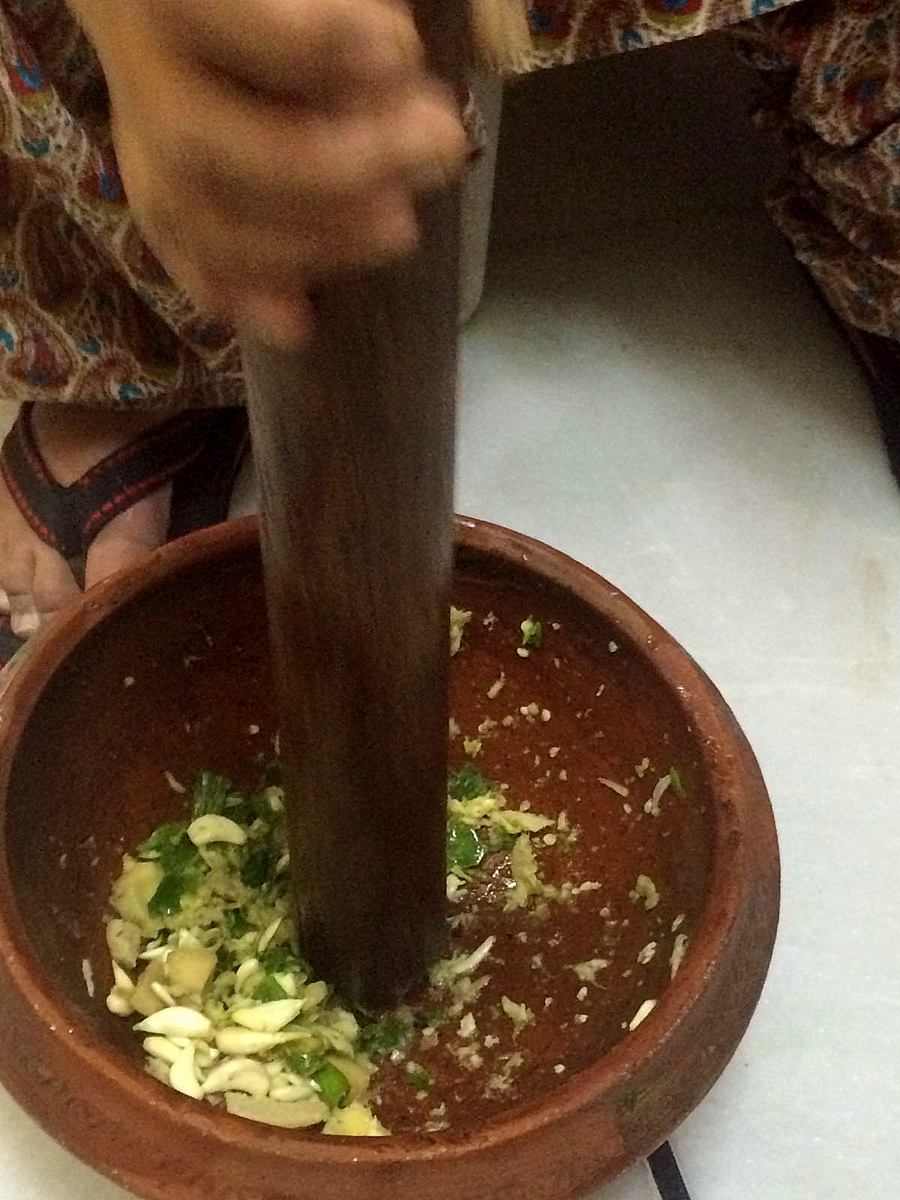

Add the ginger-garlic-green chilly paste in the saag and mix it well. Add salt to taste.


Close the lid of the pressure cooker and allow one whistle on high flame. Thereafter, reduce the flame to minimum and let the saag cook for one hour. 
Let the steam escape and then mix the saag with a hand mixer. Traditionally a 'Madani' is used which is wooden and is popularly used to make Lassi. 
The saag is basically mashed up with the Madani which requires good arm strength. 


Once mashed, little by little makai atta is added to thicken the saag. Keep adding and mixing to reach a required consistency. Put the saag back to heat for about 5 minutes so that the rawness of the makai atta goes away. 


The saag will look something like this pic below-fruit of hard labour and love that goes into making it. 


Saag at this stage can be stored in the fridge for many days. Whatever amount is required is taken out, given a tadka and then eaten.
For Tadka, take ghee/refined oil in a pan and add chopped onions. As they brown a little add chopped tomatoes and then add saag. 
Do not forget to add the most important and coveted ingredient on top of saag before serving-a big dollop of white butter ! 

Sarson da saag with Makai di roti
Sarson da saag with Bajre di roti


Makai di roti : 
  • Makai atta (a handful for each roti required)
  • hot water for kneading
  • ghee for brushing
Procedure : 
Take makai atta in a bowl and add little by little hot water into it. I initially stir it with a spoon as the water is hot but usually women in Punjab are so used to handling the hot water due to extreme winter that they do the entire kneading with hand. 
Knead it to a soft dough and keep aside covered with a wet cloth. 
They say that the makai atta because of its coarse nature yields softer roti's if kneaded with hot water. 
I take a plastic sheet and put the required ball of dough inside, cover again with the plastic sheet and then roll the roti with a rolling pin. Very commonly in Punjab women make it by just placing the ball of dough on a plastic sheet and using wet fingers to make the roti. In earlier days women were expert to make the roti by just using their two hands, no plastic sheet, no rolling pin. 
Heat a tawa and place the roti on it. Let it cook both sides and then add ghee on at least one side to let it cook and get some dark brown spots on it. 

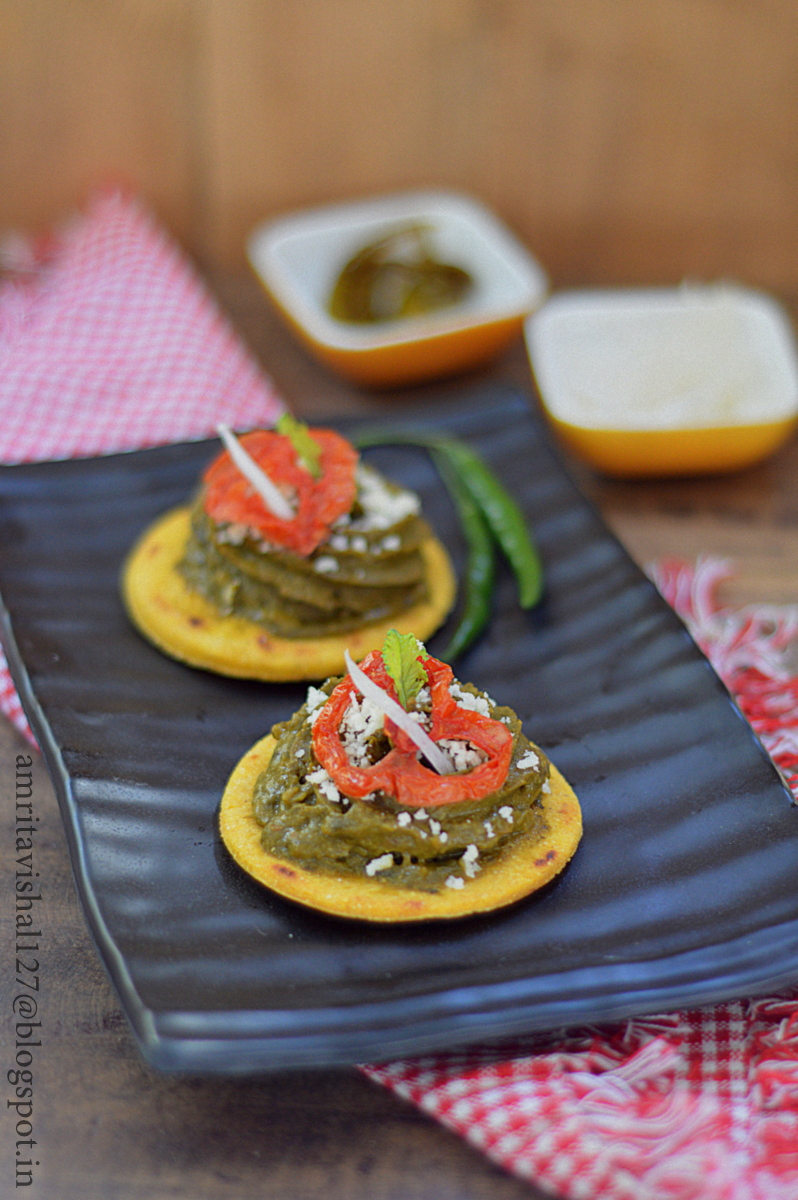
For a modern presentation, you may make small roundels of makai di roti and spoon the saag on it or you may even put saag in a piping bag and pipe on the roti like I did. Remember to keep the saag thick for this presentation. Grate some fresh paneer on top. Oven roast some slices of tomato with a sprinkle of salt and garnish on top. I used juliennes of white radish for garnishing and baby leaf of white radish. 


Makai di Tart : for 2-3 tartlets
  • 3/4 cup makai atta (maize flour)
  • 2-3 tbsp maida (all purpose flour)
  • 40 gms cold butter cut in cubes
  • little cold water for kneading dough
  • a pinch of salt

Procedure : 
Take Makai atta, all purpose flour and salt in a bowl and mix it. Add cold butter cubes in it and then rub the flour with the butter till the mixture resembles breadcrumbs in texture. Add little cold water (as much required) and knead to a dough. Wrap the dough in a cling wrap or a plastic sheet and refrigerate for 30 minutes. 
Preheat oven to 180 degree Celsius. 
Take the dough out from the fridge and leave it for 5-10 mins. Roll it out with a rolling pin and line a mini pie tin with it. Press it in the mould and cut excess from the edges. Take a fork and make few impressions to allow air to escape while baking so that the dough does not puff up. 
Bake for 10-15 minutes or till the tart is done.
Cool it and remove from tin.

Spoon a thick consistency of saag in it or pipe it with a star nozzle, as I have done. Garnish with a sprinkle of grated paneer, oven roasted tomato, julienne of radish and a radish leaf. 


Happy relishing
Amrita

Thursday, 29 September 2016

Doodh wali Tori/Turai/Jhinge/Ridge gourd


While growing up, I had no interest in food. I was too caught up with my love for music, needle work and everything else but food. Therefore, I never entered the kitchen but to seldom chop some onions for my mom. It was perhaps in those rare visits to the kitchen that I subconsciously picked up few recipes and techniques of cooking. Visual learning is pretty mighty, I discovered later in life. When I began my tryst with kitchen affairs, I would recall all of that and put them to experiment.
My Great Grand Father had come to Calcutta from Punjab and had set up his transport business. Living in Calcutta, my Great Grand-mother, my Grand-mother and then my mother adopted the local produce and used them in our typical Punjabi recipes. For example, we put the raw Papaya into our Parantha's and made a new avatar which nobody in Punjab is aware of. The raw banana found its way in our style of Kofta curry and the humble Jhinge/Ridge gourd found itself in a creamy milk and cream gravy.
This week, at Kolkata Food Bloggers the theme of our ongoing series of event is "Family Signature Recipes" where Debjani Chatterjee Alam is the featured blogger who blogs from Debjanir Rannaghar. For this event, I decided to share our family favourite recipe of Doodh wali Tori/Ridge gourd. 
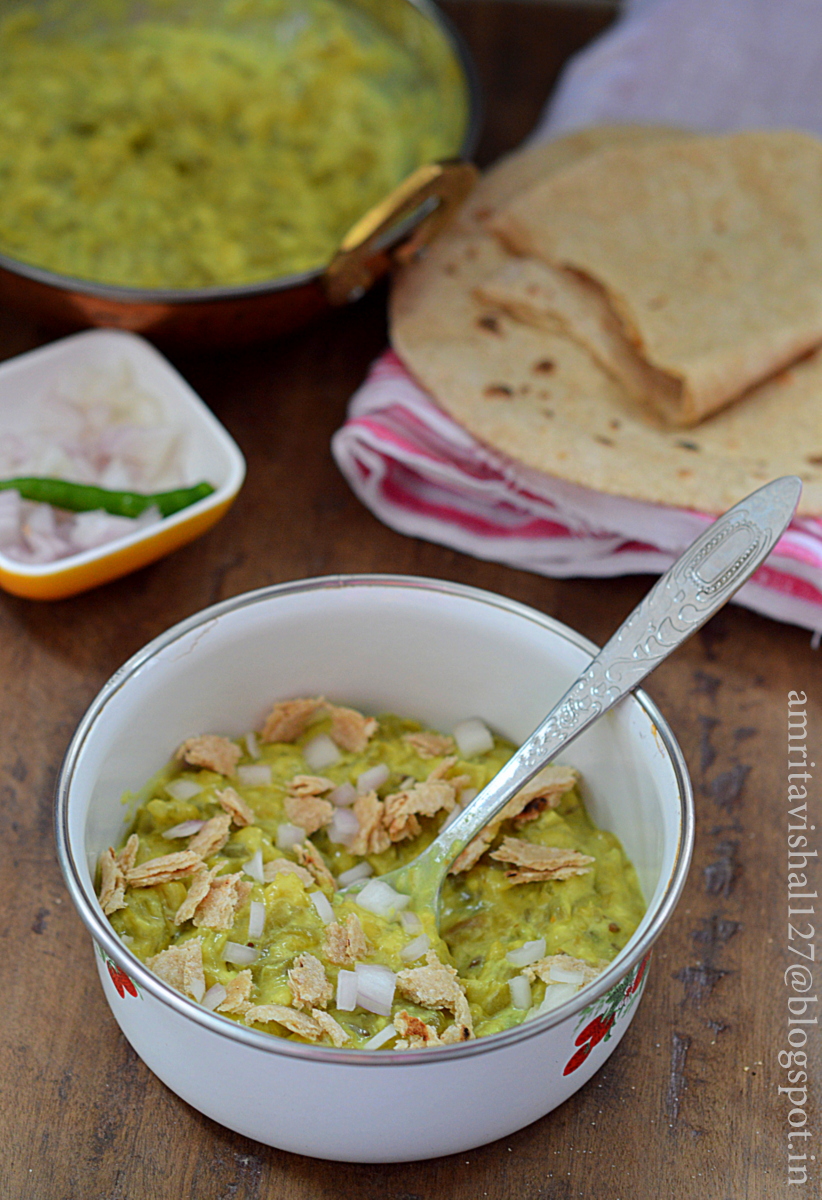
A super simple way of cooking the ridge gourd and then simmering it in milk and finishing up with some cream to give it a delicious creamy avatar. At home, at times, we make this dish with more milk and then dunk in small pieces of Roti and chopped onion to make it into a one bowl dish. 
Do try this rather amusing and simple dish of Tori/Jhinge/Ridge gourd and pair it with your Roti/Parantha and some onions.


Ingredients : For 2 servings
  • 4-5 Tori/Turai/Jhinge/Ridge gourd
  • 1 medium size onion, chopped
  • 3-4 cloves of garlic, chopped
  • 1-2 green chilly, chopped
  • 1 tsp cumin seeds
  • salt to taste
  • 1/4 tsp turmeric powder
  • 1/2 cup milk
  • 2 tbsp cream
  • 1 tbsp oil
Procedure : 
Peel and chop tori/ridge gourd.
Take oil in a pressure cooker and add cumin seeds. As they start spluttering, add chopped garlic, green chilly and onion. Let it cook for 2-3 minutes or till the onion becomes slightly brown. 
Add turmeric powder and salt and stir it well.
Add the chopped tori/ridge gourd and mix again.
Put the lid of the pressure cooker and allow 3-4 whistles on medium heat. 
Let the pressure release on its own.
Take a kadai/deep pan and add the cooked tori/ridge gourd. On medium heat, evaporate the excess water from the cooked tori. 
Now, add milk and let it cook on medium heat for 5-10 minutes or till the milk reduces to a required consistency. 
Finish off the dish by stirring in cream.

Our family favourite one bowl dish with small pieces of roti and chopped onions in the Doodh wali Tori/ridge gourd 

This recipe is part of KFB's ongoing event where Debjani is the featured blogger who blogs from Debjanir Rannaghar


Happy family recipe enjoying
Amrita

Sunday, 24 April 2016

Gond Katira(गोंद कटीरा) -Summer Cooler


Summers have hit us with a big bang. Calcutta has never seen such scorching Summers with temperature soaring to 40 degrees almost everyday. Schools have changed their timings so that little ones do not have to bear the brunt of the harsh Summer wave. We are constantly hydrating ourselves with water and sherbets. AC has become inevitable and we are trying to spend maximum time indoors.
The Summers of my childhood wasn't so unbearable. Summers meant extra bath times, eating ice creams everyday, drinking water from the earthen ware called the  à¤¤ौड़ा in Punjabi, stealing ice from the freezer, wearing those white malmal super soft frocks and  the one that I fondly remember-lying under the fan with mom's wet dupatta on top (coz we did not have or require AC then) The air that would pass the wet dupatta would become little cold and soothe us. Summers also meant travelling to Punjab for vacations where the heat was much more  and enjoying the cooler culture there. How I would love the smell of the wet khuskhus sheet behind the coolers.
Summers have changed now or perhaps we have become less tolerant. We are getting used to depending too much on gadgets and technology and forgetting the nature's way of dealing with things. Too much tampering with the nature is causing the present environmental crisis all over. We can only hope and pray that we are able to control it before it is all lost.
 
Coming back to Summers, this time I have been extra interested in the drinks that cool us. Come to think of it, every region has their specific drink to beat the heat. Punjab is a state which bears extreme Summers and Winters and therefore has food specific to beat it . For Summers, we have the Lassi's, both salty and sweet and an interesting drink called Gond Katira. In English it is called Tragacanth Gum which is basically a natural gum obtained from the dried sap of several species of Middle Eastern legumes. It has both cooling and heat producing properties to the body. When soaked in water, it is an excellent coolant whereas when fried in oil, it has heat producing characteristics. It is used extensively in Panjiri which is given to women post delivery for internal healing. In Summers it is soaked in water overnight which swells to three times its volume and is then used as a drink to cool down the body.


Ingredients : For individual serving

  • 1 tsp Gond katira/ Tragacanth gum 
  • a glass of chilled milk
  • 1-2 tbsp rose syrup
  • Sugar as required(optional)
Procedure : 
Soak gond katira in water overnight.
It will swell up to almost three times.
Wash it well with water and strain it. You may keep it in fridge till further use.
Take rose syrup in a non stick pan and reduce it on low flame for few minutes till it gets thick.
Dip the rim of the glass of choice on the thickened rose syrup.
Swirl the remaining rose syrup inside the glass on the edges all around.
Take 2 tbsp of soaked gond katira in the glass and pour cold milk over it.
Sugar can be added to the milk before pouring, in case you want it sweeter otherwise the sweetness from the rose syrup should be enough.
Garnish with some chopped rose petals.
Serve chilled.


Happy Summer beating with Coolers
Amrita

Tuesday, 5 April 2016

Rajma 'Massi wale'


Memories of my childhood are flooded with those sleeper class train journey's to Kotkapura, Punjab and the non stop fun I had with my cousins. We were together from morning to night playing, fighting, irritating each other and making the most of those few days of togetherness. It repeated every single year for a long part of my childhood and then we all grew up and went different directions. 
I have lovely memories of meal times as getting together for the family meant some special indulgence. My mamaji would always insist on dal-chawal-chokha (Dal, rice and mashed potatoes) made by my mother which was a real treat for all of us. Surprisingly, even though we are Sikh's, I remember both sides of my families relishing more on everyday vegetarian meals. No wonder I still love a simple vegetarian meal than a non-veg one. 
One such must dish during the holidays used to be my Massi's Rajma. My mom grew up with 2 sisters and 2 brothers and my Jinder Massi was the eldest of all. Jinder Massi, as I remember her from my childhood was always full of patience, love and understanding. She is such a warm hearted person who is full of understanding and love. I remember, she would deal with crisis with such composure. She as my cousin would call is Ma jaisi and therefore our Massi. 
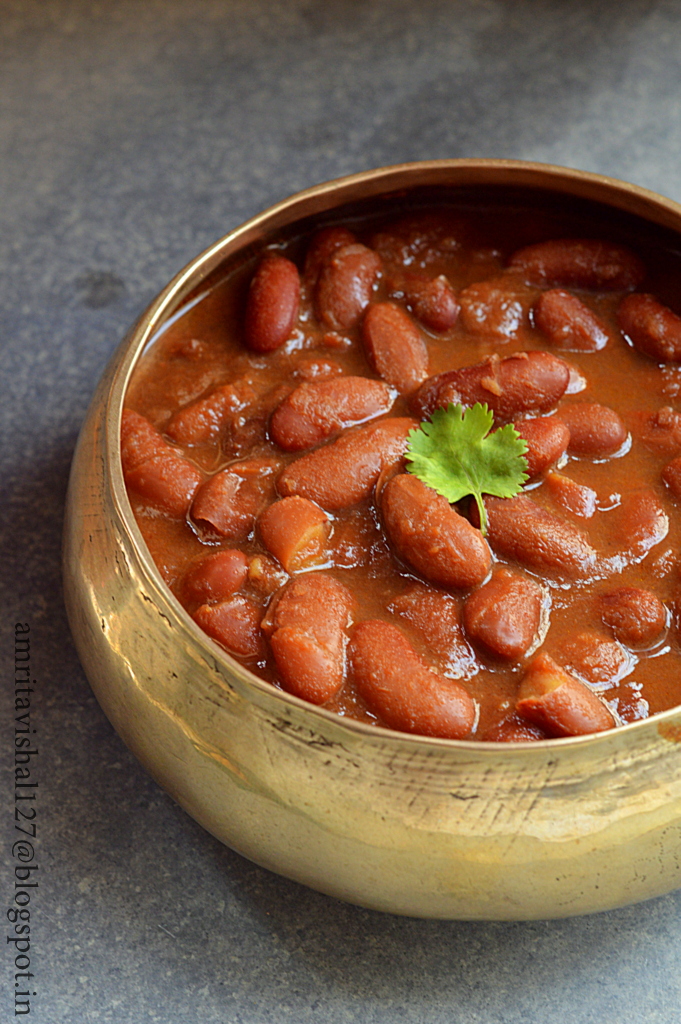
This particular recipe is a little unconventional as she likes to use a little turmeric which is otherwise not used in Rajma recipes. The masala is also cooked in a different way where you will not require a grinder. Unlike some traditional recipes where Rajma is cooked and then added to the masala, here the Rajma is cooked in the masala so that it seeps into the beans. 
I simply love to pair my bowl of Rajma with boiled rice and the sweet tomato chutney from Bengal.


Recipe courtsey : My adorable Jinder Massi

Ingredients : For 2-3 servings
  • 1 cup rajma (red kidney beans), preferably Jammu variety (soaked overnight) 
  • 1 onion, roughly chopped
  • 5-6  whole cloves of garlic
  • 1/2 " ginger, grated
  • 2 tomatoes, grated
  • 2 tbsp refined oil
  • salt as required
  • 1 tsp garam masala 
  • 1/4 tsp turmeric powder
Procedure : 
Take a pressure cooker and put chopped onions, garlic cloves and grated ginger with a splash of little water. Close the lid and let it cook for 3-4 whistles.
Let the steam escape naturally. 
Open and mash them up with the back of a ladle.
Put it back on flame and let the water evaporate completely. 
Put oil in the pressure cooker and now cook the mixture till it separates oil (for about 8-10 minutes) on medium flame. 
Add grated tomatoes and let it cook for 5 more minutes. 
Add turmeric powder and salt and cook for 2 minutes.
Now add the drained Rajma and cook it for another 5 minutes. Stir in garam masala. 
Add 3 cups of water and close the lid. 
Let it cook on high flame for 2 whistles and then reduce the flame to low and cook for another 20-25 minutes. 
Let steam escape naturally. 
Remove the lid and adjust salt.
If gravy is too thin, put it back on flame and reduce to your requirement. 
Garnish with coriander leaves. 
Pair it with roti/parantha or rice.


Happy Rajma relishing
Amrita

Sunday, 9 August 2015

Kheer Poode(पूड़े) -celebrating Teeyan(तीयां)


Saawan is the month of rains and like all other months in the Indian calendar, we have festivities attached to this month too. In Punjab this month is celebrated with 'Teeyan (तीयां) da Mela' which means fair of daughters. It is a festival where daughters go back to their maternal house and celebrate the festivity. In the olden days when women when not allowed to visit their parents house often, the women would spend this entire month with their parents and get pampered. 
Women get together and participate in the traditional dance called 'Gidda' with lots of 'Boliyans' or traditional Punjabi songs. Another mainstay of Teeyan are the swings which in earlier days used to be usually around a water body. In olden days it was a way out for women from their normal routine life and indulge in some fun and frolic.
And as far as festivity is concerned how can food be left behind. Teeyan is associated with Kheer Poode (पूड़े) , halwa, malpua and gulguley. In olden days, sugar was used scarcely and instead Gur (Jaggery) was used in everything. Traditionally the Poode are made with gur and the kheer is kept bland i.e. sans sugar which justifies the otherwise weird combination. However nowadays, poode are relished with some kind of Achaar esp Raw mango(Kaccha aam) achaar. The poode are actually crepe like and are made with whole wheat flour or Atta. The sugar or gur is dissolved in the batter and then these are spread thin on a tava with some oil to make them crisp. 
These recipes though extremely simple and humble are getting lost because the festivities are getting lost. Thankfully some families are keeping the festival of Teeyan alive so that the coming generations get a glimpse of the way things were back then. 


Ingredients for Poode : makes 7-8
  • 1 cup whole wheat flour/atta
  • 1/4 cup sugar (powdered)
  • 1/4 tsp saunf powder
  • water as required to make the batter
Procedure : 
Take atta in a bowl and mix sugar in it. Add the saunf powder and make a crepe or dosa like batter with water. 
Allow it to rest for 30-40 minutes.
Take a flat pan or tava and spread oil or ghee on it.
Pour little batter and spread it to a round.
Add more oil and crisp it from both sides.

Ingredients for kheer
  • 1 1/2 litre milk, preferably full cream
  • 1/4 cup rice, soaked in water
  • chopped assorted nuts like cashews, almonds, pista and raisins
  • elaichi powder
Procedure : 
Take milk in a heavy bottomed vessel and let it boil. Add the soaked and drained rice and let the milk reduce.
Keep stirring in between and let the rice cook in the milk. 
When the milk reduces to half the original quantity, take off from heat and cool it.
Add elaichi powder and assorted nuts(optional)
You may add sugar to your kheer if you do not want to pair it with the poode. 

Happy 'Teeyan da mela'
Amrita

LinkWithin

Related Posts Plugin for WordPress, Blogger...