Showing posts with label Milk. Show all posts

Thursday, 29 September 2016

Doodh wali Tori/Turai/Jhinge/Ridge gourd


While growing up, I had no interest in food. I was too caught up with my love for music, needle work and everything else but food. Therefore, I never entered the kitchen but to seldom chop some onions for my mom. It was perhaps in those rare visits to the kitchen that I subconsciously picked up few recipes and techniques of cooking. Visual learning is pretty mighty, I discovered later in life. When I began my tryst with kitchen affairs, I would recall all of that and put them to experiment.
My Great Grand Father had come to Calcutta from Punjab and had set up his transport business. Living in Calcutta, my Great Grand-mother, my Grand-mother and then my mother adopted the local produce and used them in our typical Punjabi recipes. For example, we put the raw Papaya into our Parantha's and made a new avatar which nobody in Punjab is aware of. The raw banana found its way in our style of Kofta curry and the humble Jhinge/Ridge gourd found itself in a creamy milk and cream gravy.
This week, at Kolkata Food Bloggers the theme of our ongoing series of event is "Family Signature Recipes" where Debjani Chatterjee Alam is the featured blogger who blogs from Debjanir Rannaghar. For this event, I decided to share our family favourite recipe of Doodh wali Tori/Ridge gourd. 
A super simple way of cooking the ridge gourd and then simmering it in milk and finishing up with some cream to give it a delicious creamy avatar. At home, at times, we make this dish with more milk and then dunk in small pieces of Roti and chopped onion to make it into a one bowl dish. 
Do try this rather amusing and simple dish of Tori/Jhinge/Ridge gourd and pair it with your Roti/Parantha and some onions.


Ingredients : For 2 servings
  • 4-5 Tori/Turai/Jhinge/Ridge gourd
  • 1 medium size onion, chopped
  • 3-4 cloves of garlic, chopped
  • 1-2 green chilly, chopped
  • 1 tsp cumin seeds
  • salt to taste
  • 1/4 tsp turmeric powder
  • 1/2 cup milk
  • 2 tbsp cream
  • 1 tbsp oil
Procedure : 
Peel and chop tori/ridge gourd.
Take oil in a pressure cooker and add cumin seeds. As they start spluttering, add chopped garlic, green chilly and onion. Let it cook for 2-3 minutes or till the onion becomes slightly brown. 
Add turmeric powder and salt and stir it well.
Add the chopped tori/ridge gourd and mix again.
Put the lid of the pressure cooker and allow 3-4 whistles on medium heat. 
Let the pressure release on its own.
Take a kadai/deep pan and add the cooked tori/ridge gourd. On medium heat, evaporate the excess water from the cooked tori. 
Now, add milk and let it cook on medium heat for 5-10 minutes or till the milk reduces to a required consistency. 
Finish off the dish by stirring in cream.
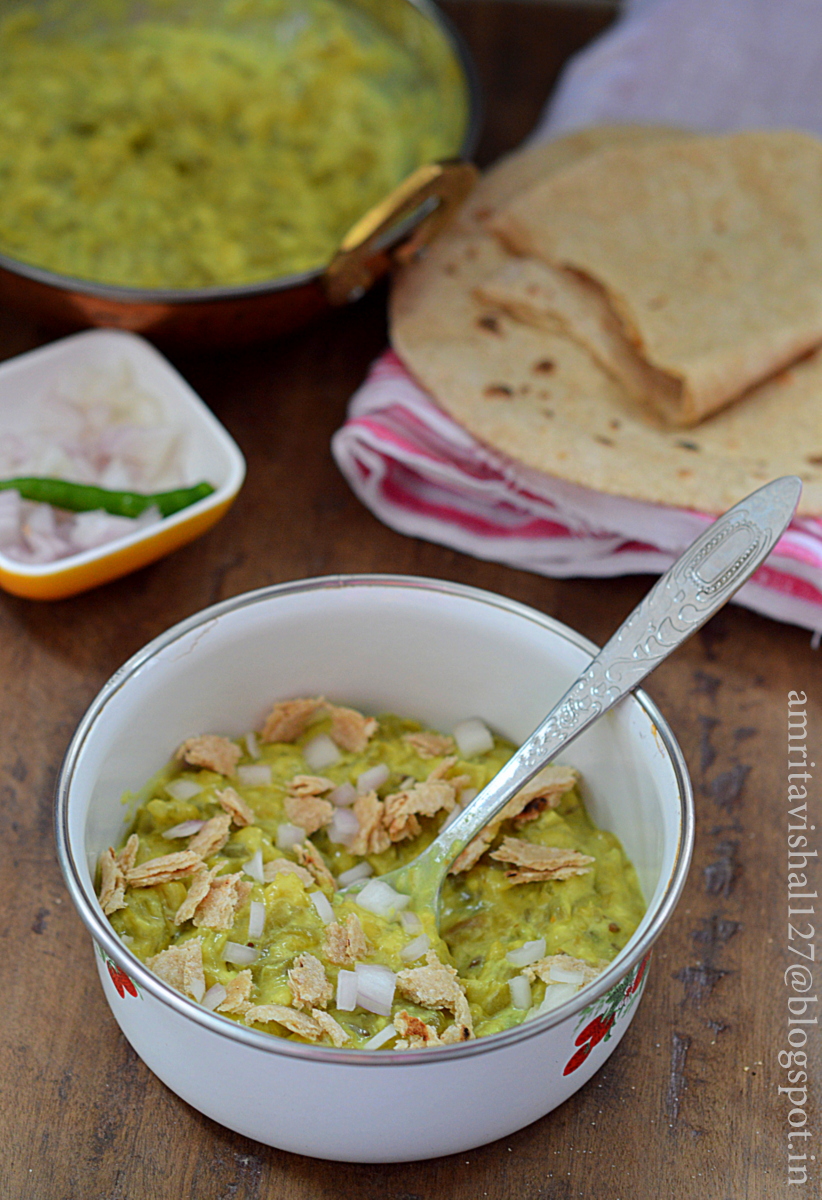
Our family favourite one bowl dish with small pieces of roti and chopped onions in the Doodh wali Tori/ridge gourd 

This recipe is part of KFB's ongoing event where Debjani is the featured blogger who blogs from Debjanir Rannaghar


Happy family recipe enjoying
Amrita

Monday, 4 July 2016

One Pot Ham and Peas Fusilli Pasta


Kolkata Food Bloggers encourages new and interactive events where its members can showcase versatility and passion. Our new ongoing event is featuring one member for a week where the chosen one gets to decide on a theme of their choice. For this week, our featured blogger is Chitrangada Kundu who blogs from Color and Spices, a blog with wonderful recipes and amazing breath-taking food photography. 
Recently, KFB held a demo workshop where Chitrangada tried explaining us a thing or two about Food photography. I was lucky to get an opportunity to attend the same and was enthralled at her knowledge and passion. With the limited time, she tried to pack in as much information as possible and shared lots of her hard-learned tips. 
For this week, our event showcases One Pot meal wonders. I have been elusive of this fuss free way of cooking and decided to try an easy pasta recipe. This is literally a dump in kind of a recipe where everything is just put in the pan and then allowed to cook. Simple and easy as a breeze, it is a quick way to beat some sudden hunger pangs.


Ingredients : Serves 2
  • 1/2 cup Fusilli Pasta
  • 1/4 cup chicken ham, cubed
  • handful of green peas
  • 1 tbsp olive oil
  • 1 medium sized onion, chopped
  • 3-4 cloves of garlic, chopped
  • salt to taste
  • black pepper to taste
  • 1 tsp of mixed dried herbs
  • 1 tbsp all purpose flour
  • 1 cup water
  • 3/4 cup milk
  • parmesan cheese for sprinkling
Procedure : 
Heat oil in a pan and saute onions till translucent. Add chopped garlic and ham cubes. Stir for a minute.
Add flour and the fusilli pasta and mix.
Stir in water and milk. 
Add salt and pepper.
Cook for 10-15 minutes and then stir in the peas.
Cook for another 5 minutes or till the pasta is done. 
Sprinkle parmesan cheese and dried herbs on top and serve. 

This recipe is part of Kolkata Food Bloggers ongoing event One Pot meals which features our blogger Chitrangada Kundu who blogs from Color and Spices


Happy Enjoying a fuss free One Pot meal
Amrita

Monday, 27 June 2016

Easy Mango Ice cream


Of the few things to love about Summers is the availabilty of the king of fruits-the Majestic Mango. I absolutely adore mangoes and have a little weak heart for the variety which is interestingly called 'Langda' or 'Langra'. The origin of the name is debateful but it is believed that since most of the names are derived from the places of origin, it too could be named after a certain place called so. But, whats in a name. Langda has a distinct taste and even though it has a green skin which might trick you into feeling its not ripe, it is one of the most sweetest mangoes. 
Vaanya, my daughter, is a mango lover too. This season she has been wanting to eat the Langda over another sweet mango called Himsagar and has been relishing her Mango escapades with the oozing nectar and the consequent mess. 
A very ripe Langda in my fridge made me kick my lazy self and turn it into an easy mango ice cream which has been in my list for a long time. This is one super simple recipe, very much like the easy strawberry one I made. It is best to make it a night before and let it set in the freezer overnight and then relish it in the day. 


 Ingredients : 
  • 3-4 tbsp condensed milk (adjust depending on the sweetness of your mangoes)
  • 1 ripe mango, peeled and pureed( I used Langda variety of Mango)
  • 1/2 cup milk
  • 1/2 cup whipped cream(see notes)
Procedure : 
In a bowl, combine milkmaid, mango puree and milk. 
Fold in the whipped cream and pour in a freeze proof tin.
Allow to set in the freezer for 5-6 hours. Best is to leave overnight.
Take out and beat the mixture and allow to set again in the freezer. Repeat this 4-5 times to break the ice crystals. 
Scoop and serve.

Note:

  • Take 1/4 cup of whipping cream and then whip it with a handheld beater till it gets thick and fluffy. 
  • In case, you do not have condensed milk, add powdered sugar to the mango puree.
  • Remember, this is a soft set variety of ice cream and therefore will not be as firm.


Happy Mango relishing
Amrita

Sunday, 24 April 2016

Gond Katira(गोंद कटीरा) -Summer Cooler


Summers have hit us with a big bang. Calcutta has never seen such scorching Summers with temperature soaring to 40 degrees almost everyday. Schools have changed their timings so that little ones do not have to bear the brunt of the harsh Summer wave. We are constantly hydrating ourselves with water and sherbets. AC has become inevitable and we are trying to spend maximum time indoors.
The Summers of my childhood wasn't so unbearable. Summers meant extra bath times, eating ice creams everyday, drinking water from the earthen ware called the  तौड़ा in Punjabi, stealing ice from the freezer, wearing those white malmal super soft frocks and  the one that I fondly remember-lying under the fan with mom's wet dupatta on top (coz we did not have or require AC then) The air that would pass the wet dupatta would become little cold and soothe us. Summers also meant travelling to Punjab for vacations where the heat was much more  and enjoying the cooler culture there. How I would love the smell of the wet khuskhus sheet behind the coolers.
Summers have changed now or perhaps we have become less tolerant. We are getting used to depending too much on gadgets and technology and forgetting the nature's way of dealing with things. Too much tampering with the nature is causing the present environmental crisis all over. We can only hope and pray that we are able to control it before it is all lost.
 
Coming back to Summers, this time I have been extra interested in the drinks that cool us. Come to think of it, every region has their specific drink to beat the heat. Punjab is a state which bears extreme Summers and Winters and therefore has food specific to beat it . For Summers, we have the Lassi's, both salty and sweet and an interesting drink called Gond Katira. In English it is called Tragacanth Gum which is basically a natural gum obtained from the dried sap of several species of Middle Eastern legumes. It has both cooling and heat producing properties to the body. When soaked in water, it is an excellent coolant whereas when fried in oil, it has heat producing characteristics. It is used extensively in Panjiri which is given to women post delivery for internal healing. In Summers it is soaked in water overnight which swells to three times its volume and is then used as a drink to cool down the body.


Ingredients : For individual serving

  • 1 tsp Gond katira/ Tragacanth gum 
  • a glass of chilled milk
  • 1-2 tbsp rose syrup
  • Sugar as required(optional)
Procedure : 
Soak gond katira in water overnight.
It will swell up to almost three times.
Wash it well with water and strain it. You may keep it in fridge till further use.
Take rose syrup in a non stick pan and reduce it on low flame for few minutes till it gets thick.
Dip the rim of the glass of choice on the thickened rose syrup.
Swirl the remaining rose syrup inside the glass on the edges all around.
Take 2 tbsp of soaked gond katira in the glass and pour cold milk over it.
Sugar can be added to the milk before pouring, in case you want it sweeter otherwise the sweetness from the rose syrup should be enough.
Garnish with some chopped rose petals.
Serve chilled.


Happy Summer beating with Coolers
Amrita

Friday, 8 April 2016

Rasmadhuri


April heralds the welcoming of new year all over India. It is amazing to see a true example of unity in diversity through the new year celebrations all over. The essence of the celebrations are more or less the same everywhere. 
Celebrated with different names, it basically marks the beginning of the harvest season and arrival of Spring.

It is called Vaisakhi in Punjab, Vishu in Kerala, Ugadi in Karnataka and Andhra pradeshChaitti in Himachal Pradesh, Mahavishuva Sankrant in Orissa, Navreh in Kashmir, Cheiraoba in Manipur, Puthandu in Tamil Nadu, Gudi Padwa in Maharashtra, Rongali Bihu in Assam.
Poila Boishakh is celebrated in West Bengal which literally means first day of the first month. An auspicious time for marriages and beginning of all business activities, it is celebrated with traditional dressing and food. 
Born and brought up in Kolkata, I have had a mixture of celebrations with each festival. To me, Poila Boisakh means the rustle and bustle at Chaitra sales, cleaning up the house spic and span, throwing away old unwanted things and bringing in new stuff. No Bengali festival is complete without their elaborate meals and it is the perfect time of the year to visit eateries serving traditional Bengali thali's-the amish and niramish ones. People are seen jostling in their favourite sweet shops to buy the most coveted mishti for the celebrations. Each shop burns the midnight oil to create sweet delicacies which are devoured with much fun and fervour.
Poila Boisakh is also incomplete without the traditional dressing. It is so wonderful to see the passionate and artistic community of Bengalis stick to their roots and wear traditional dresses. So while women don their favourite sarees, the men are seen with their Panjabi or dhoti. Even the little ones are seen donning traditional dresses. 
Bengali is one of the sweetest known language and throughout the day it is lovely to hear people wishing each other in the melodious 'Shubho Noboborsho'. 
An important part of new year is the cleaning of the house. It is Spring cleaning time of the year where old unwanted things are thrown away, houses are painted, nook and corners cleaned of dirt and pests. This is time of the year when the Summer has just entered the city and humidity is also a bit high hence cockroaches sneak out from their hiding and make their way into our homes, crawling in through the dirty drain pipes bringing in all the disease causing bacteria with them. The most easiest and sure shot way to get complete rid of them is Godrej LAL HIT, with its deep reach nozzle, it is able to get rid of the cockroaches hiding in your kitchen sink outlet, under the gas cylinder or under your fridge. This ensures a hygienic environment for the family which is of utmost importance, esp during Poila Boisakh where we are eager to cook the quintessential and delicious Payesh. From this Poila Boisakh onwards, make it a point while cleaning your kitchen to use Godrej LAL HIT in the places where cockroaches hide frequently-like sink outlets, under the fridge and gas cylinder and around the dustbin. 
I planned to try my hands on a mishti for this new year and have come up with Rasmadhuri where a rasagulla log is sandwiched with a saffron infused sandesh and then covered with the same. In the essence of the traditional festivity, I have placed the mishti in banana leaf wrappers. 


Ingredients : Yields about 6 in number
  • 500 ml cow's milk (or full cream milk)
  • 1 tbsp lemon juice/a pinch of citric acid
  • 1/2 cup sugar
  • 1 1/2 cup water
  • a tsp each of chopped almonds, pista and raisins
  • few strands of saffron in little warm milk
  • 2 tbsp powdered sugar
Procedure : 
Heat milk in a pan and let it come to a boil. 
Add citric acid/lemon juice and stir well. 
Soon you will see the milk curdling and whey separating. 
Wait till the whey separates well.
Remove from heat and using a muslin cloth drain the chenna(curdled milk) from whey. 
Hang the muslin cloth to drain excess water for half an hour. 
Remove and put on a plate. Cover with another plate and put a heavy object to drain any remaining liquid for about half an hour.
Take out the chenna and knead with the heel of your palm till smooth and reaches dough consistency. This requires patience and strong arm muscles and can take around 10 minutes.
Make cylindrical shapes out of 1/3 rd of the kneaded chenna and keep remaining aside.

Make sugar syrup by boiling 1/2 cup sugar and 1 1/2 cup water in a wide mouthed pan. 
Lower the log shaped chenna very gently in the sugar syrup.
Let them simmer on medium heat for 15-20 minutes or till they begin floating on the surface. 
Strain out the chenna cylinders and reserve for further use.

Alternatively, take sugar and water in a pressure cooker and as the syrup comes to a rolling boil, lower the chenna cylinders. Put the lid on and cook on medium heat for 2 whistles. Allow the heat to dissipate naturally and take out the cooked chenna cylinders.

Divide the remaining kneaded chenna again into two. To one part add  1 tbsp powdered sugar, chopped nuts and saffron infused milk. 
Cut the chenna cylinders into half and sandwich with the nuts and saffron milk added chenna.


Place these sandwiched logs in Banana leaf wrappers.

Add 1 tbsp of milk and 1 tbsp powdered sugar to the 1/3rd remaining chenna and mix it well. Add more milk if required to get a diluted consistency. Fill the banana leaf wrappers with this diluted chenna. 
Refrigerate for it to set.
Garnish with  saffron coloured streaks on top and a pista. 


Banana leaf wrapper can be made very easily at home. Here is a picture tutorial. 

Disclaimer : This post is in association with Godrej LAL HIT.

Shubho Noboborsho
Amrita

Wednesday, 2 March 2016

Chocolate glazed Doughnuts


It is amazing how we can push our abilities in times of need. Recently I had the opportunity to participate in a bake sale and managed to churn out quite some goodies in no time. I was amazed at my speed and realized that lack of time is always just an excuse we give ourselves.  
Amongst all the ideas that were floating in my head, I had almost ditched the thought of baking doughnuts because I was really not sure of its sale. But then there was this rising impulse inside me that made me jump up and make the dough and allow it to rest. The fluffy dough was then cut in the shape of a doughnut and fried to a beautiful golden colour. The doughnuts tasted light and fluffy and along with the chocolate glaze turned out to be an absolute treat. 
The icing on my baked goodies is always the family approval esp my daughter's. She was dying to put her hands on the chocolate slathered and sprinklers loaded doughnuts. I waited with a bated breath and saw her reaction as she picked one doughnut. Her head swung in an 'Ummmm' and I instantly knew I had baked goodness. 
The sale did not go too well and I ended up bringing most of the goodies at home. No one regretted as it meant a week long sweet feast at home. :)


Recipe source : Adapted from here

Ingredients : I have reduced the recipe to half and achieved about 14 medium sized doughnuts
  • 1/2 tbsp instant yeast
  • 1/2 cup or more warm milk
  • 1/4 cup powdered sugar
  • 1 egg
  • 1/4 tsp salt
  • 2 1/2 cup all purpose flour
  • 2 tbsp butter, softened
  • refined oil for frying
  • dark chocolate, melted
  • Sprinklers
Procedure : 
Take flour, sugar, salt and yeast in a bowl. Stir.
Add egg. Stir.
Add warm milk a little at a time and knead to a smooth dough. You may require more than 1/2 cup of milk. 
Add butter and knead. 
Take another bowl and grease it. Put the dough in it and cover with a damp muslin cloth. Leave it for an hour or more to double in size. 
You can also refrigerate the dough after the rise in case you want to use next day. Just let it come to room temperature before you roll, cut and fry.
Roll your dough and cut in doughnut shape using round cookie cutters of different size. Let it sit for 1/2 - 1 hour.  
I usually knead the hole back in the dough. You may like to fry them separately too. 
Put oil to fry the doughnuts in a deep pan.
Fry the doughnuts in medium heat till they are golden brown.
Drain on a kitchen towel or a tissue napkin.
Keep melted chocolate in a wide bowl. Dip the doughnuts in it halfway and sprinkle with colourful sprinklers. 
Doughnuts are best eaten the same day, almost soon after frying. You can also refrigerate excess dough and fry fresh as and when needed


Kolkata Food Bloggers are organizing a one of its kind Bake'rs Showcase featuring the best talent in Homebaker's. Folks in Kokata, please book your date and join us in this endeavor where you are guaranteed to find some amazing and creative bakes. Find more details here .


Happy Doughnut eating
Amrita

Sunday, 21 February 2016

Paneer Florentine


I have been struggling to push myself and blog more on the regular savoury food that we have at home. But often, since I like to prepare food fresh and on time, I seldom get to click pictures and thus post on it. A stronger push was thus necessary to let readers know that I do eat things beyond all the cakes and cookies I keep posting. 
Frankly speaking I rarely eat my own sweet bakes and I bake in small quantities sufficient for my daughter and husband. So the regular everyday meal is just like in any other home though I must confess that I am a little lazy in savoury experiments.
Paneer florentine was born out of circumstances of unavailability. Many years ago, myself and Vishal had a dish called Fish Florentine in a restaurant called One step up on Park street. Vishal being the savoury experimenter at our home, decided to give it a try and it came out quite wonderful.
While trying out the same dish in Allahabad, we were stuck at an odd hour where we could not find fish so we thought of trying the same with Paneer. The dish came out wonderful and we were surprised how the humble paneer fitted perfectly in this French dish. 
The word Florentine (pronounced Flor-en-teen), in culinary world, refers to a recipe that is prepared in the style of the Italian region of France. Florentine recipes typically feature a bed of Spinach on which a main ingredient such as meat, poultry or fish is laid and then topped with a Mornay sauce which is a béchamel sauce with shredded or grated Gruyère cheese and an egg yolk. A florentine recipe may also be topped with cheese which is browned as in au gratin.


Ingredients : For 2-3 servings
  • half a bunch of spinach leaves
  • 2-3 cloves of garlic, chopped
  • 150 gms Paneer, cut in cubes
  • 1/2 tbsp butter
  • 1/2 tbsp refined oil
  • 1/2 tbsp all purpose flour (maida)
  • 1/2 tbsp whole wheat flour (atta)
  • 1 1/2 cups milk, warm
  • 1/4 cup mozzarella cheese, grated
Procedure : 
Wash spinach leaves very well.
Boil water in a pan and add the spinach leaves. Turn off the heat and immediately drain the spinach leaves and put in cold water. Drain and roughly chop.
Take oil in a pan and saute half of the chopped garlic. 
Add the spinach and saute for a while. Season with salt.
Lay the spinach in a baking tray of your choice.
Place the paneer cubes randomly on it.


Preheat oven to 180 degree Celsius.
Now, make the béchamel sauce (basic white sauce) by taking butter and oil in a pan. As soon as the butter melts, add the all purpose flour and whole wheat flour. Turn the heat to medium and keep stirring till the flour turns a little brown.
Meanwhile keep milk a little warmed up. Pour this warm milk to the pan and stir continuously till the sauce thickens to the required consistency. Warm milk is poured to avoid the formation of lumps in the sauce.
Season with salt and black pepper.


Pour white sauce on the paneer cubes in the baking pan. 


Sprinkle the grated mozzarella cheese on top and some dried parsley. 
Bake for 15 minutes or till the cheese melts and gets a beautiful brown colour. 
Serve with Garlic toasts or plain buttered toasts.  


Happy Florentine-ing
Amrita


Friday, 16 October 2015

Kheer tarts


Its that time of the year when Calcutta dresses up in its fineries to welcome Ma Durga. The little nip in the air and the fragrance of the Shiuli phool (night jasmine or harshringar) are the heralds of Durga Puja - a festival which is incomparable to others. The zest and enthusiasm to dress up in new clothes and visit pandals all across the city is seen in every Calcuttan irrespective of them being Bengali or not. The intricacies of the beautiful work done in Pandals makes everyone hold their breath and wonder at the hard work that has been put in, only to be demolished after the Puja is over. 
As with any other festivity, Durga Puja is also synonymous to great food. Grand plans are chalked out which includes pandal hopping and eating out. From street vendors to five star hotels, every place is packed up with people and each place tries to give the best and attractive offers.
Since the blossoming of Shiuli phool marks the beginning of the month of this festivity, I wanted to incorporate it in my picture shoot. Along with Vishal, my husband, we hunted down many flower vendors but did not find any. While buying some vegetables, I asked the lady vendor in Bangla, "Didi, shiuli phool kothaye pabo?"(Where will I find Shiuli flower?) She smiled and said, "Aamake aage bolte, aamaar badi samne koto phool maati te pode thake" (Why did you not tell me earlier. In front of my house, these flowers are found fallen on the ground) She was sweet enough to ask me to come the next day and collect it from her. And that is how I got these humble little fragrant flowers for the shoot!
The idea of this recipe has an interesting story too. Last month while visiting a Gurudwara, 3 hours away from Calcutta, we happened to cross one of the small towns called 'Kheerpai'.The name intrigued us all and we were contemplating the place to be famous for a certain kheer served in a pie form. Since I wanted the dessert to be bite sized, I experimented with these Kheer tarts. I was fortunate to find some nolen gur from last year in my fridge. You can try the same with normal sugar and enjoy this month of festivity. 


Ingredients :

Tarts : Makes 6-8 tarts
  • 1/2 cup all purpose flour
  • 25 gms butter, cut in cubes, cold
  • 3 tbsp powdered sugar
  • 1 tsp milk
  • cold water, as required for kneading
Kheer :
  • 500 ml milk, full cream
  • 1 rice, washed (I used Gobindbhog)
  • 2-3 tbsp nolen gur(date palm jaggery) You may use sugar or sugarcane jaggery

Procedure : 

Tarts : 

Take flour and butter in a bowl and rub the butter cubes with the flour till the mixture resembles breadcrumbs (in texture).
Mix in the powdered sugar and add milk.
Now add cold water 1 tbsp at a time and knead to get a smooth dough. Do not over knead.
Wrap the dough in a cling wrap or plastic sheet and refrigerate for half an hour. 
Take a little bit of the dough and press it against the tart mould. Starting from the center press out the excess dough and remove it. 
Take a fork and make holes on the dough in the tart mould. 
Refrigerate the tart moulds again for 10-15 mins.
Meanwhile, preheat oven to 180 degree Celsius.
Place the tart moulds in the oven and bake for 10-15 mins.

Kheer : 

Pour milk in a thick bottomed pan and bring it to a boil.
Lower the flame and add the washed rice.
Let the milk cook, on a medium flame, stirring in between till it reduces to half its original quantity. 
Once the milk has thickened to the desired consistency, turn off the heat.
Wait for a couple of minutes and then add the grated/crushed nolen gur. Mix well. Adjust sweetness to your liking.
In case you want to use sugar, add it once the milk has thickened and still on the flame. 

Preheat the oven to 180 degree Celsius.
Add a spoonful of the kheer in the tart shells and bake for 5-10 minutes.
Cool and garnish with some chopped pistachios, cardamom powder and some grated nolen gur.


This recipe is part of Kolkata Food Bloggers ongoing event : Puja week-Mishti special 


Happy Durga Puja
Amrita

Sunday, 9 August 2015

Kheer Poode(पूड़े) -celebrating Teeyan(तीयां)


Saawan is the month of rains and like all other months in the Indian calendar, we have festivities attached to this month too. In Punjab this month is celebrated with 'Teeyan (तीयां) da Mela' which means fair of daughters. It is a festival where daughters go back to their maternal house and celebrate the festivity. In the olden days when women when not allowed to visit their parents house often, the women would spend this entire month with their parents and get pampered. 
Women get together and participate in the traditional dance called 'Gidda' with lots of 'Boliyans' or traditional Punjabi songs. Another mainstay of Teeyan are the swings which in earlier days used to be usually around a water body. In olden days it was a way out for women from their normal routine life and indulge in some fun and frolic.
And as far as festivity is concerned how can food be left behind. Teeyan is associated with Kheer Poode (पूड़े) , halwa, malpua and gulguley. In olden days, sugar was used scarcely and instead Gur (Jaggery) was used in everything. Traditionally the Poode are made with gur and the kheer is kept bland i.e. sans sugar which justifies the otherwise weird combination. However nowadays, poode are relished with some kind of Achaar esp Raw mango(Kaccha aam) achaar. The poode are actually crepe like and are made with whole wheat flour or Atta. The sugar or gur is dissolved in the batter and then these are spread thin on a tava with some oil to make them crisp. 
These recipes though extremely simple and humble are getting lost because the festivities are getting lost. Thankfully some families are keeping the festival of Teeyan alive so that the coming generations get a glimpse of the way things were back then. 


Ingredients for Poode : makes 7-8
  • 1 cup whole wheat flour/atta
  • 1/4 cup sugar (powdered)
  • 1/4 tsp saunf powder
  • water as required to make the batter
Procedure : 
Take atta in a bowl and mix sugar in it. Add the saunf powder and make a crepe or dosa like batter with water. 
Allow it to rest for 30-40 minutes.
Take a flat pan or tava and spread oil or ghee on it.
Pour little batter and spread it to a round.
Add more oil and crisp it from both sides.

Ingredients for kheer
  • 1 1/2 litre milk, preferably full cream
  • 1/4 cup rice, soaked in water
  • chopped assorted nuts like cashews, almonds, pista and raisins
  • elaichi powder
Procedure : 
Take milk in a heavy bottomed vessel and let it boil. Add the soaked and drained rice and let the milk reduce.
Keep stirring in between and let the rice cook in the milk. 
When the milk reduces to half the original quantity, take off from heat and cool it.
Add elaichi powder and assorted nuts(optional)
You may add sugar to your kheer if you do not want to pair it with the poode. 

Happy 'Teeyan da mela'
Amrita

LinkWithin

Related Posts Plugin for WordPress, Blogger...