Showing posts with label Spinach. Show all posts

Thursday, 26 January 2017

Sarson da saag with Makai di tart


As Winter comes, all homes in Punjab get geared up to prepare the most important, the most loved and the most respected meal-Sarson da saag and Makai di roti. This is not just another meal for us but is a meal which is synonymous to our culture and our existence. The sight of beautiful yellow flowers on the mustard plant are an invitation to the most coveted and most awaited meal during Winters. 
This hearty and healthy combination is supposed to warm the bodies to fight the bitter cold. The entire process of making Sarson da saag is not just a process but a ritual which is done very religiously. 
On my recent visit to Punjab, I was lucky to have sarson da saag from someones fields which was fresh and organic. The stem of the leaves of sarson da saag is called 'Gandalan' and a saag made using this part is supposed to be the best saag. The stem is first peeled and this is called 'Chirana' to remove any hard fibre and then all the leaves are washed. The leaves are then chopped using a traditional 'Daat' which is very much like a 'Boti' used in Bengal. The leaves are then cooked in the pressure cooker along with ginger-garlic-green chilly paste and then the saag is mashed using a traditional 'Madani' or 'Ghotna'. Makai atta is then added little by little to thicken the saag and give it some body. This is called 'Aalan'. Alternatively, besan or gehun atta can also be used. The saag is then again put to cook the rawness of the atta. 
Usually saag is cooked in more quantity as it stores very well. In fact, the older it gets the more tastier it gets. When required, a tadka of onions and tomato is given to the saag which is then served with a dollop of white butter or 'Chitta Makhan'. 
Since a recipe of Sarson da saag is so common and readily available everywhere on the net, I was more interested to present it in a little different and modern way. The perks of having an amazing Chef friend is that you can discuss your food planning and get incredible ideas and tips. And that is what lead me to attempt my hands on a Makai da tart. The entire innovative credit goes to my friend cum super chef Vikas Puri who very patiently helped me plan the styling. 
The recipe credit goes to my dear Kamal Masi who also very patiently helped me click and document each step of Saag making. The recipe and method shared here is the traditional way we make it at our home. 


Ingredients :


Organic greens-fresh produce from the farms
Sarson da Saag- For 7-8 servings

  • 3 bunch Sarson saag (Mustard leaves)
  • 1 bunch palak (spinach)
  • 1 bunch bathua (chenopodium leaves)
  • 1 bunch methi (fenugreek leaves)
  • 1 bunch methe, optional (a variety of fenugreek leaves)
  • handful of garlic leaves 
  • 2 tbsp ginger-garlic paste
  • 3-4 green chillies (less or more, according to taste)
  • 2 tbsp makai atta (maize flour)
  • salt to taste
  • ghee
Procedure : 

Sarson da saag : 

Peel the ends of the stems of the Sarson saag leaves. The stems are called 'Gandal' and a saag made of these gandals is a delicacy. Popularly saag made of these stems is called 'Gandalan da saag'. 


Wash all the leaves and then chop them. Traditionally it is done with an instrument called 'daat' in Punjabi (also called 'boti' in Bengali).


Heat 3 cups water in a pressure cooker and keep adding the chopped greens to it. Add more water if required. The chopped greens should get just about soaked in the water. 


As the leaves get cooked, they will change colour and settle down. Stir it once in a while. Meanwhile prepare ginger-garlic-green chilly paste by grinding them all together.
Traditionally, it is done in a vessel called 'Kunda-Sota' where an earthen vessel is the 'Kunda' and a wooden stick is the 'Sota'. The masala is pounded in the kunda with the sota.  
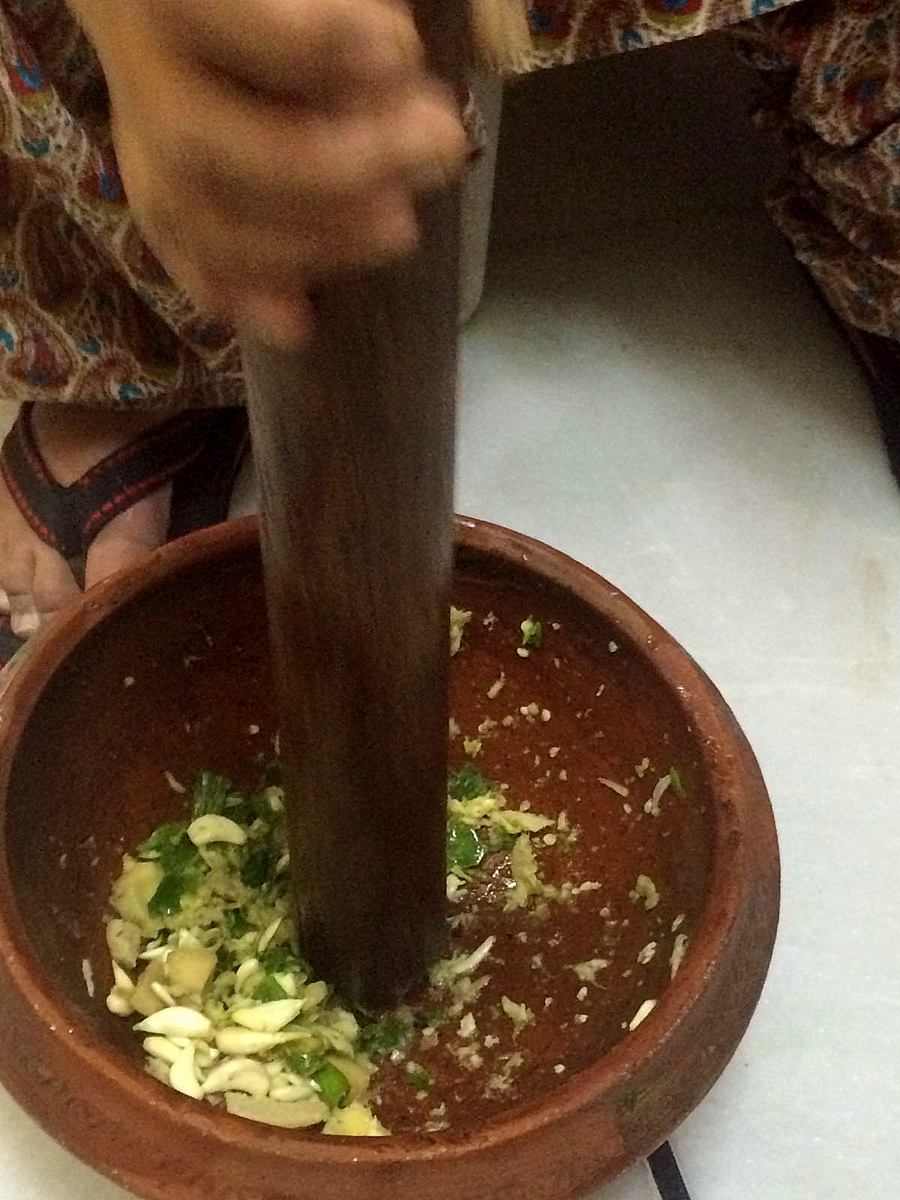

Add the ginger-garlic-green chilly paste in the saag and mix it well. Add salt to taste.


Close the lid of the pressure cooker and allow one whistle on high flame. Thereafter, reduce the flame to minimum and let the saag cook for one hour. 
Let the steam escape and then mix the saag with a hand mixer. Traditionally a 'Madani' is used which is wooden and is popularly used to make Lassi. 
The saag is basically mashed up with the Madani which requires good arm strength. 


Once mashed, little by little makai atta is added to thicken the saag. Keep adding and mixing to reach a required consistency. Put the saag back to heat for about 5 minutes so that the rawness of the makai atta goes away. 


The saag will look something like this pic below-fruit of hard labour and love that goes into making it. 


Saag at this stage can be stored in the fridge for many days. Whatever amount is required is taken out, given a tadka and then eaten.
For Tadka, take ghee/refined oil in a pan and add chopped onions. As they brown a little add chopped tomatoes and then add saag. 
Do not forget to add the most important and coveted ingredient on top of saag before serving-a big dollop of white butter ! 

Sarson da saag with Makai di roti
Sarson da saag with Bajre di roti


Makai di roti : 
  • Makai atta (a handful for each roti required)
  • hot water for kneading
  • ghee for brushing
Procedure : 
Take makai atta in a bowl and add little by little hot water into it. I initially stir it with a spoon as the water is hot but usually women in Punjab are so used to handling the hot water due to extreme winter that they do the entire kneading with hand. 
Knead it to a soft dough and keep aside covered with a wet cloth. 
They say that the makai atta because of its coarse nature yields softer roti's if kneaded with hot water. 
I take a plastic sheet and put the required ball of dough inside, cover again with the plastic sheet and then roll the roti with a rolling pin. Very commonly in Punjab women make it by just placing the ball of dough on a plastic sheet and using wet fingers to make the roti. In earlier days women were expert to make the roti by just using their two hands, no plastic sheet, no rolling pin. 
Heat a tawa and place the roti on it. Let it cook both sides and then add ghee on at least one side to let it cook and get some dark brown spots on it. 

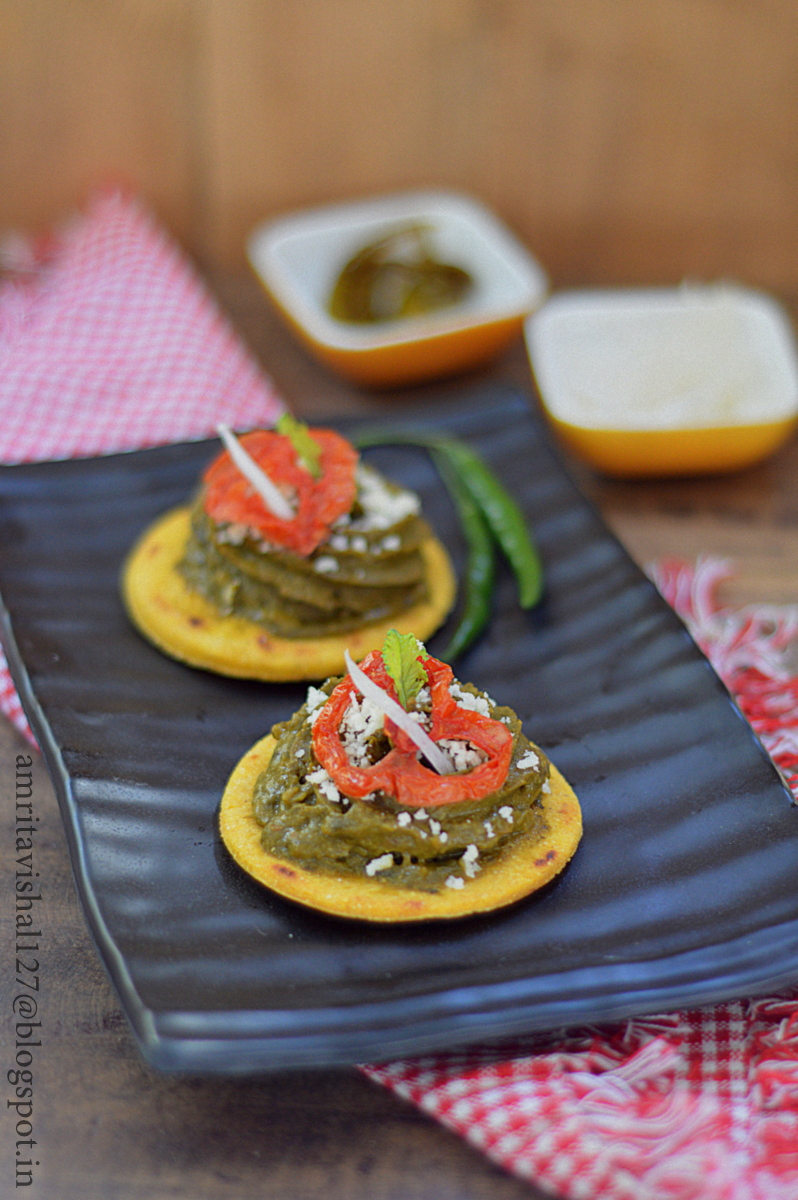
For a modern presentation, you may make small roundels of makai di roti and spoon the saag on it or you may even put saag in a piping bag and pipe on the roti like I did. Remember to keep the saag thick for this presentation. Grate some fresh paneer on top. Oven roast some slices of tomato with a sprinkle of salt and garnish on top. I used juliennes of white radish for garnishing and baby leaf of white radish. 


Makai di Tart : for 2-3 tartlets
  • 3/4 cup makai atta (maize flour)
  • 2-3 tbsp maida (all purpose flour)
  • 40 gms cold butter cut in cubes
  • little cold water for kneading dough
  • a pinch of salt

Procedure : 
Take Makai atta, all purpose flour and salt in a bowl and mix it. Add cold butter cubes in it and then rub the flour with the butter till the mixture resembles breadcrumbs in texture. Add little cold water (as much required) and knead to a dough. Wrap the dough in a cling wrap or a plastic sheet and refrigerate for 30 minutes. 
Preheat oven to 180 degree Celsius. 
Take the dough out from the fridge and leave it for 5-10 mins. Roll it out with a rolling pin and line a mini pie tin with it. Press it in the mould and cut excess from the edges. Take a fork and make few impressions to allow air to escape while baking so that the dough does not puff up. 
Bake for 10-15 minutes or till the tart is done.
Cool it and remove from tin.

Spoon a thick consistency of saag in it or pipe it with a star nozzle, as I have done. Garnish with a sprinkle of grated paneer, oven roasted tomato, julienne of radish and a radish leaf. 


Happy relishing
Amrita

Sunday, 21 February 2016

Paneer Florentine


I have been struggling to push myself and blog more on the regular savoury food that we have at home. But often, since I like to prepare food fresh and on time, I seldom get to click pictures and thus post on it. A stronger push was thus necessary to let readers know that I do eat things beyond all the cakes and cookies I keep posting. 
Frankly speaking I rarely eat my own sweet bakes and I bake in small quantities sufficient for my daughter and husband. So the regular everyday meal is just like in any other home though I must confess that I am a little lazy in savoury experiments.
Paneer florentine was born out of circumstances of unavailability. Many years ago, myself and Vishal had a dish called Fish Florentine in a restaurant called One step up on Park street. Vishal being the savoury experimenter at our home, decided to give it a try and it came out quite wonderful.
While trying out the same dish in Allahabad, we were stuck at an odd hour where we could not find fish so we thought of trying the same with Paneer. The dish came out wonderful and we were surprised how the humble paneer fitted perfectly in this French dish. 
The word Florentine (pronounced Flor-en-teen), in culinary world, refers to a recipe that is prepared in the style of the Italian region of France. Florentine recipes typically feature a bed of Spinach on which a main ingredient such as meat, poultry or fish is laid and then topped with a Mornay sauce which is a béchamel sauce with shredded or grated Gruyère cheese and an egg yolk. A florentine recipe may also be topped with cheese which is browned as in au gratin.


Ingredients : For 2-3 servings
  • half a bunch of spinach leaves
  • 2-3 cloves of garlic, chopped
  • 150 gms Paneer, cut in cubes
  • 1/2 tbsp butter
  • 1/2 tbsp refined oil
  • 1/2 tbsp all purpose flour (maida)
  • 1/2 tbsp whole wheat flour (atta)
  • 1 1/2 cups milk, warm
  • 1/4 cup mozzarella cheese, grated
Procedure : 
Wash spinach leaves very well.
Boil water in a pan and add the spinach leaves. Turn off the heat and immediately drain the spinach leaves and put in cold water. Drain and roughly chop.
Take oil in a pan and saute half of the chopped garlic. 
Add the spinach and saute for a while. Season with salt.
Lay the spinach in a baking tray of your choice.
Place the paneer cubes randomly on it.


Preheat oven to 180 degree Celsius.
Now, make the béchamel sauce (basic white sauce) by taking butter and oil in a pan. As soon as the butter melts, add the all purpose flour and whole wheat flour. Turn the heat to medium and keep stirring till the flour turns a little brown.
Meanwhile keep milk a little warmed up. Pour this warm milk to the pan and stir continuously till the sauce thickens to the required consistency. Warm milk is poured to avoid the formation of lumps in the sauce.
Season with salt and black pepper.


Pour white sauce on the paneer cubes in the baking pan. 


Sprinkle the grated mozzarella cheese on top and some dried parsley. 
Bake for 15 minutes or till the cheese melts and gets a beautiful brown colour. 
Serve with Garlic toasts or plain buttered toasts.  


Happy Florentine-ing
Amrita


Thursday, 29 October 2015

Crepes with Spinach Paneer filling


This Durga Puja turned out the best one for Vishal Vaanya and me as we had the lovely company of my sis-in-law and her family from Lucknow. We spent seven crazy days full of fun, non stop eating out and visiting beautiful places. It was more of a 're-discovering Kolkata' for me and I have replenished my love for the city. 
Park street, as usual, enthralled us with its beauty and I discovered some lovely restaurants there serving amazing food. Along with my niece, I enjoyed the street food served opposite Vardaan market from the famous Puchka's, Bhelpuri, Jhaalmuri and the irresistible Kulfi. With my sis-in-law, I discovered some amazing shops that I have never visited before. The Santiniketan trip was like a cherry on the cake. I was unaware that there exists such a relaxing and beautiful getaway from the city life. 
Well, everything good comes to an end and their short trip ended soon and now we are struggling to come back to our routine life. 
This particular recipe was tried a month back when I saw it on a tv show. I am a sucker when it comes to breakfast options and the fusion crepes shared on the program excited me. The healthy ingredients made the otherwise 'lazy Savoury experiment' person in me try them soon. 
I served the crepes with some balsamic vinegar and honey glazed beetroot. 
(To make them, take olive oil in a pan and add the chopped beetroot. Add balsamic vinegar, honey and soy sauce and let it cook. Adjust seasoning and serve.)


Ingredients : 

Crepes : 
  • 4 tbsp all purpose flour (maida)
  • 4 tbsp besan (gram flour)
  • a pinch of turmeric powder and red chilli powder
  • salt to taste
Filling : 

  • two handfuls of spinach leaves, washed and finely chopped
  • 50 gms paneer, crumbled
  • 1/4 cup sweet corn kernels
  • a small onion, chopped
  • 1/2 tsp jeera (cumin seeds)
  • 1 tbsp oil
  • salt to taste


Procedure : 

Filling : 
Heat oil in a pan.
Add jeera and as it splutters, add chopped onion.
Cook for a minute and add the chopped spinach leaves.
Cook for another minute or two and then add the crumbled paneer , sweet corn kernels and salt. 
Mix and cook for another minute. 
Allow to cool.


Crepes : 
Take all purpose flour and besan in a bowl. 
Add turmeric powder, red chilli powder and salt and mix well.
Add water, as much as required, to attain a crepe like consistency. 
Heat a non stick pan and pour a little oil.
Add a ladle full of the crepe batter and let it cook.
Turn side and allow to cook.
Remove and let it cool to touch.

Take a crepe and make a slit from the centre.
Arrange the filling on the side next to the slit in a triangular manner.
Start rolling the crepe in a triangular shape with the filling till you finish the entire circle.
You may saute the rolled crepe on the oiled pan again to give it a glaze on top. 


Happy healthy indulgence
Amrita

Monday, 12 August 2013

Tiranga/Tricolour Pasta-Unity in Diversity


Unity in Diversity

India is the largest country in the world where one can see people belonging to different religion, caste and creed, speaking numerous languages, with a vast array of food habits and diverse culture live together and proudly proclaim themselves as Indians. Each aspect of our lives reflects the expression 'Unity in Diversity' because with all our differences we still stand united.  

This year as India gears up to celebrate its 67th Independence Day, which falls on the 15th of August, I am reminded of the good old school days when Independence Day was a day to reach school on time to be present for the flag hoisting ceremony and participate in the march past, which traditionally is followed by patriotic songs. The beautiful lines of a Bengali song 'Dhono Dhanne Pushpe Bhora' where the lines 'Aamar ei deshe tei jonmo, jeno ei deshetei mori' means that 'I wish that I die in this land where I was born', still echoes in my mind over and over again.
 
As students we would sing our beautiful National Anthem 'Jana Gana Mana' and were taught to give it utmost respect. When it is sung and played in television or radio, it was put very simply by one of our teacher to either stand up in attention while it is playing or just turn off the source (TV or radio) if we were too lazy to stand up and respect it in reverence.
As an adult, I see many of us Indians disrespect our National Anthem. People usually are so casual when it is sung or played. I often see people just sitting, smiling or talking without realising that the minimum requirement of each citizen of this wonderful country is to respect our National Flag and the National Anthem. 
 
Another thing which annoys me is when people ridicule our country. We need to understand that we are not living in a perfect country and no other country is as perfect as we might think them to be. There are issues like poverty, crime and corruption that needs to be dealt with on a consistent basis. I personally believe that if one cannot say good things about their country and have some responsibility towards it sustenance and reformation then they should also not have the right to ridicule or condemn.
These matters might look very trivial but they shape our collective outlook towards our country. We need to individually dig deep inside ourselves and see what we can contribute towards our country. It does not matter if those things are as small as throwing garbage in the bin and not on the streets or as big as having the responsibility to lead the nation in various spectrums of representation or administration. Each and every thought, action and words makes a characteristic difference.

Coming to today's post, I have tried to incorporate three different sauces which represent the colours of our flag and make one dish out of it. A reflection of 'Unity in Diversity'!


Ingredients : For 2-3 servings. I used a 3 1/2" round cookie cutter to set the layers

  • 1 cup Pasta- I used Fusilli

Orange layer
  • 1/3 piece of a medium sized Red Bell Pepper
  • 1 medium sized Tomato
  • 1 clove of garlic, chopped
  • a tbsp of chopped onion
  • 1 tsp Parmesan Cheese
  • salt and pepper to taste
  • 1 tbsp of Tomato ketchup
  • Olive Oil to saute
 White layer 
  • 1/2 tbsp butter
  • 1/2 tbsp all purpose flour
  • 1/2 cup warm milk
  • salt and pepper to taste
  • 1 tsp Parmesan cheese(Alternately use regular processed cheese)
Green layer
  • 1/4 cup spinach leaves
  • 2-3 sprigs Parsley leaves, roughly chopped
  • 1 clove garlic, chopped
  • 1 tbsp chopped onions
  • salt to taste
  • 1 tsp Parmesan cheese
  • Olive oil to saute
 
Procedure :
 
Orange (Roasted Bell pepper)sauce
Apply little oil and roast the red bell pepper and tomato on Gas flame till the skin is slightly charred. Alternatively you may even roast them in the oven.
Let it cool slightly and scrape off the skin. 
Grind the roasted red bell pepper and tomato to a fine paste.
Take oil in a pan and saute garlic and onion till onions turn translucent. 
Add the ground red bell pepper and tomato paste.
Cook for a minute and add salt &pepper to taste. 
Mix in tomato ketchup.
Add parmesan cheese and mix well. 
Remove from heat and keep aside.

White (Cheesy)sauce
Take butter in a pan and as it melts add flour. 
Saute the flour a little and add warm milk. Stir well to avoid lump formation.
Season with salt and pepper.
Add cheese and stir. As the sauce thickens, remove from heat and keep aside.

Green (Spinach)sauce
Blanch spinach leaves in boiling water for a minute. Remove from heat and transfer to bowl of cold water to maintain the colour. Grind with parsley leaves to a paste to make a puree.
Take oil in a pan and saute garlic and onion till onions turn pink. 
Add spinach-parsley puree and cook for a minute.
Season with salt and pepper.
Add cheese and stir. 
Remove from heat and keep aside.

Pasta
Take a deep vessel and boil water. 
Add salt and a tsp of olive oil and put the pasta in it. 
Check the pasta for doneness by pinching between your fingers. Take care not to overcook the pasta. This can take anywhere between 5-10 mins depending on the type of pasta you choose.
Drain the water and keep the pasta aside to cool.

Divide the pasta in three batches and add to the prepared sauces. Mix properly so that it gets incorporated well. 

Take a round cookie cutter and spread the green layer of pasta using the back of a spoon. Similarly spread the white and then the orange layer.
Carefully remove the cookie cutter and garnish with Red, yellow and green bell pepper juliennes.


Happy Independence Day
Amrita

LinkWithin

Related Posts Plugin for WordPress, Blogger...